
Ruby Franke Case: Coercive Control in Parenting
Examines how coercive control turned strict parenting into severe child abuse in a high-profile family vlogger case and the legal, social lessons it revealed.

Ruby Franke, once a popular YouTube personality with her channel 8 Passengers, documented her strict parenting style to an audience of millions. However, what began as a portrayal of family life unraveled into a shocking case of abuse. In 2023, her 12-year-old son escaped their home, revealing severe physical and psychological harm inflicted by Franke and her business partner, Jodi Hildebrandt. The two women were later convicted of aggravated child abuse and sentenced to up to 30 years in prison.
The case highlighted coercive control in parenting, where discipline escalated into domination and abuse. Tactics included isolation, deprivation, and manipulation, all justified under religious and moral pretenses. This behavior left the Franke children physically injured, malnourished, and emotionally scarred. The story also raised concerns about the role of social media in masking abuse, as well as systemic failures in safeguarding children.
Key points from the case:
- Parenting tactics: Extreme punishments, food deprivation, and psychological manipulation.
- Influence of Jodi Hildebrandt: Religious extremism and control tactics worsened the abuse.
- Impact on children: Severe physical injuries, emotional trauma, and long-term psychological damage.
- Legal and societal implications: Challenges in identifying coercive control and gaps in child protection systems.
This case serves as a grim reminder of how unchecked authority and coercive tactics can lead to devastating outcomes for children.
Ruby Franke Prosecutor Tells All: ‘Horrific Abuse’
What Is Coercive Control in Parenting
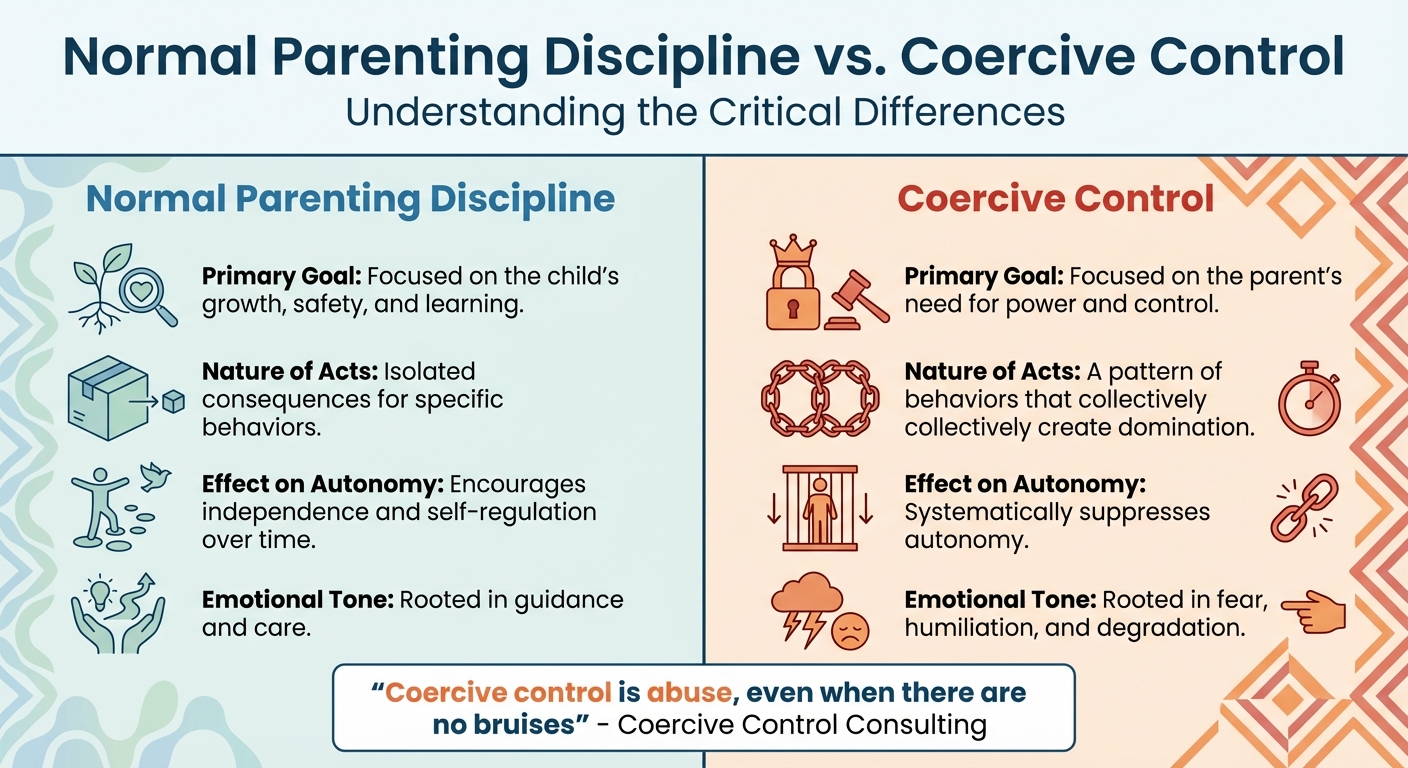
Normal Parenting Discipline vs Coercive Control: Key Differences
Coercive control in parenting isn’t just about occasional anger or enforcing strict rules. It’s a persistent pattern of behavior aimed at dominating a child and stripping away their sense of independence. Timothy A. Carey, Ph.D., a professor at Central Queensland University, explains:
"The core of coercion is making people act according to your wishes and not theirs. It is the requirement to act according to someone else's demands that removes a person's freedom".
This harmful dynamic relies on tactics that combine to form what legal experts describe as a "mosaic" of abuse. Isolation ensures the child is cut off from friends, extended family, and any external support that could challenge the parent’s authority. Micromanagement dictates every aspect of the child’s daily life, from what they wear and eat to when they sleep and where they go. Surveillance involves constant monitoring, whether through technology, excessive questioning, or controlling communications and finances. Psychological manipulation uses techniques like gaslighting and triangulation to create confusion and conflict.
The consequences of coercive control go far beyond discipline. Children subjected to this form of parenting often develop hypervigilance, constantly analyzing facial expressions and tones for signs of danger. They grow up believing that love is conditional - earned only through complete obedience - and that survival depends on suppressing their own needs and feelings. Larissa Crane, LICSW, RYT, emphasizes:
"Coercive control is a form of abuse that rarely leaves visible scars. But it leaves deep psychological wounds. It is designed to dominate, isolate, and destabilize".
This pattern of manipulation closely mirrors the dynamics observed in the Franke household.
How Coercive Control Is Defined
The behaviors described above form the foundation for legal and psychological definitions of coercive control. By definition, coercive control is a pattern in which one person unreasonably interferes with another's freedom and autonomy. A major milestone occurred in 2015 when the United Kingdom introduced Section 76 of the Serious Crime Act. This law acknowledged that domestic abuse doesn’t have to involve physical violence to be considered criminal. It recognized that while individual acts might seem minor or even reasonable on their own, together they create a pattern of abuse.
The key to this definition lies in intent and consistency. Coercive control isn’t about a parent having a bad day or making a single mistake. It’s about a deliberate, ongoing effort to restrict autonomy and maintain dominance. Economic abuse is often a significant component, involving financial control, resource gatekeeping, and enforced dependency - even in families with significant wealth.
How Coercive Control Differs from Normal Discipline
These definitions help clarify why coercive control is fundamentally different from normal parenting discipline. The distinction lies in the purpose and impact of the actions. Normal discipline is meant to teach boundaries, promote safety, and encourage independence over time. Coercive control, on the other hand, is about the parent’s desire for absolute power and domination. While all parenting involves some level of control, coercive control crosses the line by actively preventing children from developing their own sense of identity or autonomy.
| Feature | Normal Parenting Discipline | Coercive Control |
|---|---|---|
| Primary Goal | Focused on the child's growth, safety, and learning | Focused on the parent's need for power and control |
| Nature of Acts | Isolated consequences for specific behaviors | A pattern of behaviors that collectively create domination |
| Effect on Autonomy | Encourages independence and self-regulation over time | Systematically suppresses autonomy |
| Emotional Tone | Rooted in guidance and care | Rooted in fear, humiliation, and degradation |
Normal discipline is built on consistent rules and clear boundaries that children can understand and eventually internalize. Coercive control, on the other hand, functions as psychological warfare, teaching children that their value lies only in complete obedience. As Coercive Control Consulting puts it:
"Coercive control is abuse, even when there are no bruises".
Some victims have even reported that they’d prefer physical abuse because it has a clear endpoint, unlike the constant, unrelenting dominance of psychological control.
Warning Signs in 8 Passengers Videos

Ruby Franke's YouTube channel, 8 Passengers, became a platform where everyday parenting crossed into troubling territory. Through videos documenting coercive control, psychological manipulation, and public humiliation, viewers were shown how discipline was turned into a tool for domination.
Documented Incidents That Raised Public Concern
One incident from May 2020 captured widespread attention. Ruby Franke shared a video where her 15-year-old son, Chad, admitted he had been sleeping on a beanbag chair for seven months as punishment for a prank on his younger brother. Ruby laughed as Chad shared this, sparking outrage. A Change.org petition demanding a CPS investigation quickly gained nearly 18,000 signatures.
Food deprivation also stood out as a recurring theme. In one instance, Ruby refused to bring lunch to her 6-year-old daughter, Eve, after the child forgot to pack it for school. Ruby explained her reasoning in a text to Eve's teacher:
"Eve is responsible for making her own lunches in the morning, so the natural outcome is she is just going to be hungry. And hopefully, nobody gives her food and nobody steps in and gives her a lunch because then she's not going to learn."
Ruby's disciplinary methods often involved psychological intimidation. In one video, she threatened to decapitate Eve's favorite teddy bear as punishment for using scissors improperly. The video showed Eve crying as Ruby waved the toy in front of her.
Public humiliation was another tactic. After catching Chad using a phone at the dinner table, Kevin Franke read Chad's private text messages to a crush aloud, both to the family and the YouTube audience.
In August 2019, Ruby and Kevin revealed that Chad had been absent from their vlogs for 10 weeks because he was sent to the Anasazi Foundation Wilderness Therapy Program. The program was described as a way to help Chad develop "basic maturity skills." At the time, Chad was just 14 years old.
These incidents not only alarmed viewers but also highlighted how Ruby justified her actions, presenting them as deliberate parenting choices.
How Authority Was Displayed on Social Media
Ruby Franke's social media presence amplified her approach to parenting. She framed acts of deprivation and humiliation as "teaching moments" or "natural outcomes", portraying herself as a firm but principled parent rather than an abuser. Her authority was often reinforced through a tone of moral superiority, as she laughed at her children's distress in videos. When faced with criticism, Ruby defended her methods, saying:
"What people aren't understanding is that we give our children choice in everything. We are teaching our children to be self-governing."
This narrative allowed her to dismiss concerns while normalizing behaviors that many saw as coercive control. These behaviors included isolating her children, micromanaging their lives, and using manipulation under the guise of discipline.
Despite a CPS visit in 2020, the case was closed as "unsupported". Ruby continued to document her controversial parenting style until she and her partner, Jodi Hildebrandt, were sentenced to up to 30 years in prison for aggravated child abuse in 2024.
How Jodi Hildebrandt Escalated the Abuse
When Jodi Hildebrandt Entered the Family
Jodi Hildebrandt joined the Franke family dynamic in 2019, initially as Chad's counselor. Over time, her role expanded - she became Ruby's mentor and effectively took on the position of the family's marriage counselor. By 2021, she had moved into the Franke home, claiming to be plagued by "shadow figures." Using her credentials as a mental health professional, Hildebrandt began labeling family members with issues like "addictions" and "deception." This further deepened Ruby's isolation from her husband and children, amplifying the control already present. Adding to the turmoil, the family faced a financial collapse in 2020 after losing 90% of their income due to backlash against their YouTube content. This crisis drove Ruby to lean even more on Hildebrandt, whose influence led Ruby toward what Washington County Attorney Eric Clarke referred to as "religious extremism".
Using Religion to Justify Abuse
Under Hildebrandt's growing influence, the Franke household underwent a dramatic ideological shift. Hildebrandt weaponized religious language, portraying the children as "possessed by the devil" and advocating for pain as a way to "expel evil." Practices like starvation were reframed as "fasting" to humble the children, while forced manual labor in 91°F heat was described as "physical activity of obedience".
Ruby's own journal entries illustrate this disturbing mindset. In one entry, she wrote:
"If you can engage a weak minded soul in a physical activity of obedience you can begin to break the bond Satan made w/ the weak."
Another entry revealed her refusal to provide basic care:
"I will not feed a demon."
Hildebrandt's "ConneXions" program enforced a rigid framework, categorizing all behaviors as either "Truth" or "Distortion." This ideology encouraged parents to cut ties with spouses and isolate their children. Hildebrandt also claimed to experience prophetic visions, such as riding a giant lion alongside "heavenly parents." These claims elevated her to a near-messianic figure within the household. Ruby even viewed Hildebrandt's thick notebook of "visions" as potential scripture.
This misuse of religion and authority set the stage for even more extreme changes in the family's structure and daily life.
Changes to Family Structure and Relationships
Hildebrandt's control over the Franke family led to sweeping changes in their relationships and living conditions. By 2022, she had ordered Kevin Franke to leave the family home, requiring him to complete her counseling sessions before being allowed to return. Kevin later described the experience to investigators:
"I knew that the only way I would ever get back into my house was I had to get Jodi's approval. But it felt like an impossible task. … Every week, it was like, 'You're being manipulative, you're being selfish, you're lying, you're hiding something.' And I really started to question my sanity."
The household became a harsh, regimented environment. The children were deprived of basic necessities like food, water, and beds, and were forced to endure grueling punishments such as endless wall sits and carrying heavy boxes up and down stairs. One particularly shocking journal entry from Ruby in July 2023 detailed how her 12-year-old son's hair was shaved off as a punishment. On his birthday, she noted that he "doesn't even know what month it is", a grim reflection of his extreme isolation.
Between May and August 2023, the abuse escalated further at Hildebrandt's home in Ivins, Utah. Court records reveal horrifying incidents, including forcing a 9-year-old girl to jump on a cactus, withholding food from a 12-year-old boy, and making the children carry heavy boxes for extended periods. The abuse finally came to light on August 30, 2023, when the 12-year-old boy escaped with duct tape on his extremities and sought help. Both Hildebrandt and Ruby Franke were arrested, pleaded guilty to four counts of aggravated child abuse, and received sentences of up to 30 years in prison.
Religious and Cultural Factors in the Case
Mormon Teachings on Parental Authority
Ruby Franke and Jodi Hildebrandt twisted mainstream religious teachings to justify their abusive actions. The Church of Jesus Christ of Latter-day Saints explicitly condemns child abuse, calling it "sinful, tragic and in total opposition to the teachings of the Savior". However, these women manipulated cultural teachings to rationalize their behavior. Ruby Franke, for instance, became obsessed with the concept of "exact obedience." In her journal, she wrote that her son needed to be "100% obedient with exactness. No wavering. No hiding" to follow the example of the Savior. Religious historian John-Charles Duffy noted that while LDS culture does emphasize obedience and repentance, Franke distorted these principles to dangerous extremes. She used them as tools of coercive control, turning teachings about spiritual discipline into excuses for both physical and psychological domination.
The family's YouTube channel, 8 Passengers, which amassed 2.5 million subscribers, played a significant role in spreading their warped ideology. Kevin Franke later described the channel as a form of missionary work, stating, "We believed that we were sharing Christianity with the whole world. And in return, God was blessing us". Ruby’s belief that portraying a perfect Mormon family was a spiritual obligation further fueled her actions, using the platform to promote a distorted version of religious values.
Unfortunately, this misuse of traditional teachings opened the door to even more extreme and apocalyptic ideologies.
Apocalyptic Beliefs and Increased Control
Hildebrandt’s influence introduced an apocalyptic worldview that heightened her control over the Franke family. She claimed to have prophetic visions, including surreal imagery like riding a giant lion with "heavenly parents." Ruby believed these visions were significant enough to be recorded as scripture. This apocalyptic mindset became a justification for their abusive practices, reframing them as part of a divine mission.
The women also embraced literal beliefs in demonic possession, using this as a rationale for their actions. Washington County Attorney Eric Clarke explained, "The women appeared to fully believe that the abuse they inflicted was necessary to teach the children how to properly repent for imagined 'sins' and to cast the evil spirits out of their bodies". Ruby’s journal entries further illustrate this disturbing perspective. She described beating her son while proclaiming, "I have the power of God and he must obey. I beat Satan. I win".
Ruby’s sentencing statement revealed how deeply these apocalyptic beliefs had disconnected her from reality. She said, "I was led to believe that this world was an evil place, filled with cops who control, hospitals that injure, government agencies that brainwash, church leaders who lie and lust". Hildebrandt’s "Truth vs. Distortion" framework only deepened this isolation. By labeling any dissent as evidence of satanic influence, the women created a closed system where extreme abuse was reframed as a spiritual duty. These warped religious and cultural beliefs became the foundation for the coercive control that dominated the Franke household.
Effects on the Franke Children
Physical Harm from Abuse
The physical abuse suffered by Ruby Franke's children was both horrifying and life-threatening. In August 2023, when 12-year-old R managed to escape through a window, neighbors captured footage of him on a Ring camera. The images revealed his emaciated frame and duct tape binding his extremities. Emergency responders later discovered deep, open wounds on his wrists and ankles - injuries caused by handcuffs and ropes that had been tied so tightly they tore into muscle and tissue. Shockingly, these wounds had been treated with a mixture of honey and cayenne pepper before being sealed with duct tape.
Both R and his 9-year-old sister, E, were severely malnourished. R had been forced to endure grueling manual labor outdoors in Utah's sweltering summer heat, where temperatures often exceeded 90°F. For weeks, he worked without shoes, leading to repeated sun and contact burns. Medical reports described his skin as "blistered and sloughing". When medics assessed his condition, they concluded that R likely would not have survived more than two weeks had he not escaped. E's condition was equally dire. When police found her hiding in a bathroom closet, she was so starved that she immediately devoured a personal pizza and half of a large one after officers coaxed her out. The children were routinely deprived of food, water, and adequate sleeping conditions, all under the guise of "repentance".
While the physical injuries were devastating, the emotional scars ran just as deep.
Long-Term Psychological Damage
The psychological abuse inflicted on the children was equally harrowing. R had been manipulated into believing that imprisonment was a necessary step in his "repentance." Before his first attempt to escape in July 2023, he used small pebbles to spell out the message, "Jail. I will call when I get there", on the concrete where he had been forced to sleep. Deputy Washington County Attorney Zachary Weiland explained, "They told these kids that you have to repent first and then you're going to jail".
The children were made to believe they were inherently evil, possessed, or even demonic. Ruby Franke's journal revealed her disturbing mindset, as she attributed her son's incontinence to "satanic choices and deviant behavior" rather than recognizing it as a symptom of severe psychological distress. When officers found E, she was so terrified that she remained frozen in the closet for four hours, refusing to speak or interact. Prosecutors described the emotional torment as so extreme that the children came to internalize the abuse, believing they deserved such treatment.
How Courts Handle Coercive Control in Child Abuse Cases
Prosecuting coercive control in child abuse cases comes with unique hurdles. One of the biggest challenges is separating abusive behavior from strict, but lawful, parenting. In Ruby Franke's case, she initially framed her actions as part of a "natural consequences" parenting philosophy. This approach might have seemed reasonable at first glance, but it unraveled when undeniable physical evidence of abuse came to light.
Courts are increasingly using a "mosaic" approach to evidence, piecing together smaller acts to reveal a pattern of criminal abuse. Rachel Cook, Of Counsel at Peters & Peters, explained it well: "Individually, acts may appear trivial or even reasonable. Together, they can amount to criminal abuse". In the Franke case, prosecutors presented a range of evidence, including a 60-page handwritten journal, Ring camera footage showing one child escaping, and police body camera recordings of another child hiding in a closet. This method of combining evidence highlights the complexity of such cases, especially when ideological beliefs come into play.
Religious ideology added another layer of difficulty. Franke and her associate, Jodi Hildebrandt, justified their actions as necessary "repentance" to rid the children of "evil spirits". The Washington County Attorney's Office noted, "The women appeared to fully believe that the abuse they inflicted was necessary to teach the children how to properly repent for imagined 'sins' and to cast the evil spirits out of their bodies". This belief system blurred the line between intent and abuse, complicating legal arguments.
The high-profile nature of the case also posed challenges, particularly in selecting an impartial jury. Before its deletion, the Franke family's "8 Passengers" YouTube channel had around 2.5 million followers, making it hard to find jurors without preconceived notions. Legal expert RonNell Andersen Jones highlighted this issue, stating, "The law has always had to figure out how to keep trials focused on only the admissible evidence, but in an era in which some people live huge swaths of their life on camera... it's a much more complicated task". Judges had to carefully determine which parts of the family's online presence were relevant evidence versus mere public persona.
Coercive Tactics Used on Different Family Members
The patterns of coercive control in the Franke household reveal a harrowing system of targeted abuse, with each family member enduring distinct forms of mistreatment. These tactics were tailored to exploit vulnerabilities and enforce control over every aspect of their lives.
The children were subjected to extreme physical abuse, with punishments that varied depending on their ages and perceived misbehavior. For instance, the 12-year-old son was restrained with ropes and handcuffs, forced to perform outdoor labor barefoot in scorching summer temperatures, which caused severe skin injuries. His wounds were then "treated" with cayenne pepper and honey before being covered with duct tape. The 15-year-old son endured months without a bed, sleeping on a beanbag for seven months. Meanwhile, the 6-year-old daughter was denied lunch at school as part of a lesson in "natural consequences". The children were repeatedly labeled as "evil", "possessed", or "Satanic", and Ruby documented her belief that physical pain was necessary, writing:
"the more numb your child is the bigger the outcome they need to wake them up".
These punishments reflected a calculated hierarchy of abuse, escalating with the perceived vulnerability of each child.
Ruby Franke herself experienced psychological and spiritual manipulation. Jodi Hildebrandt played a central role, isolating Ruby from her family and influencing her moral compass. Ruby's legal team described this as fostering a "distorted sense of morality". Through shared "visions" and "trances", Hildebrandt convinced Ruby that her actions were divinely guided, deepening Ruby's dependence on her.
Kevin Franke's experience differed, highlighting another form of domestic coercion. He faced strict rules within the household, needing Ruby's permission for basic activities like entering the kitchen, eating, or speaking to her. This enforced dependency left Kevin increasingly reliant on Ruby's approval. In July 2022, over a year before the arrests, Kevin was removed from the home entirely, marking the culmination of his alienation.
Table: Tactics, Targets, and Outcomes
| Tactic | Target | Purpose | Outcome |
|---|---|---|---|
| Physical restraint (ropes/handcuffs) | 12-year-old son | To suppress escape attempts | Severe tissue damage; emaciation |
| Cayenne pepper on wounds | 12-year-old son | "Treatment" for injuries | Increased pain and physical torture |
| Spiritual manipulation (visions/trances) | Ruby Franke | To instill a "distorted sense of morality" | Led to abusive behavior |
| Domestic isolation (permission-based living) | Kevin Franke | To create psychological dependency | Alienation from children |
| Shaving hair | 9-year-old daughter | Punishment for "refusing to work" | Psychological trauma; documented in journal |
| Ousting from home | Kevin Franke | Removal of "untruthful" influences | Separation; divorce filing |
These tactics illustrate a deliberate strategy of domination, designed to isolate and control each family member while reinforcing a toxic power dynamic within the household.
Lessons from the Ruby Franke Case
The Ruby Franke case highlights alarming failures in identifying and addressing coercive control, where early warning signs were dismissed as strict parenting. These oversights created an environment where abusive behavior could thrive unchecked.
The situation severely escalated when 12-year-old "R" managed to escape, barely surviving the ordeal. In July 2022, Kevin Franke was removed from the home and lost contact with his children for over a year. Shortly after, the children were withdrawn from school and moved to a remote location, cutting off critical external oversight.
The family's online presence added another layer of complexity. Their "8 Passengers" YouTube channel presented a polished, profitable image that masked the abuse happening behind the scenes. Shari Franke, one of Ruby's children, later shared that her mother's on-camera persona hid the extent of the mistreatment.
Unqualified influencers like Jodi Hildebrandt played a dangerous role in this case. Without proper credentials, Hildebrandt promoted harmful beliefs, convincing Ruby that inflicting physical pain was divinely justified. This created a warped dynamic - a "folie à trois" - where abuse was reframed as part of a spiritual battle against evil.
In response to these failures, policymakers are pushing for reforms to address the systemic gaps. Proposed measures include Utah's HB83, which would make it easier to obtain warrants when parents deny access to their homes, and the "Make Homeschool Safe Act", which would mandate risk assessments before children can be withdrawn from traditional schools. Rachel Cook, Of Counsel at Peters & Peters, emphasized the importance of these changes:
"The criminal law finally recognised that abuse does not have to be violent to be devastating. Patterns of domination, intimidation, and control, often invisible from the outside, were brought within the scope of criminal liability".
FAQs
How can you tell strict parenting from coercive control?
Strict parenting emphasizes firm rules and discipline but still respects a child's independence. On the other hand, coercive control - like what was highlighted in Ruby Franke's case - relies on isolation, dependency, and manipulation to strip away autonomy. Coercive control creates an environment of emotional manipulation, often cutting victims off from their support systems. The main distinction is that coercive control is abusive, fostering psychological harm and dependence, whereas strict parenting can maintain boundaries without causing such harm.
What are early warning signs a child is being coerced or isolated?
Children experiencing coercion or isolation often show troubling signs that can be both physical and psychological. On the physical side, you might notice malnourishment, untreated wounds, or signs of extreme physical pain. Psychologically, these children may carry a heavy sense of blame, feel destabilized, or even be unfairly labeled as "difficult."
Behaviorally, patterns of emotional abuse, manipulation, and isolation tend to emerge. In the most severe cases, children might resort to desperate measures like climbing out of windows or seeking help from others to escape their circumstances. These actions highlight the urgency of their situation and the need for intervention.
Why is coercive control so hard to prove in court?
Coercive control is tough to establish in court since it typically involves subtle, continuous behaviors that don’t always appear as clear-cut criminal acts. Legal proceedings demand substantial evidence of repeated patterns, such as manipulation, isolation, and psychological dominance - elements that are often hard to document or visibly prove.