
Timeline of Madeleine McCann's Disappearance
Chronological account of the 2007 Praia da Luz disappearance, early investigative failures, Operation Grange, and the 2020 German suspect with ongoing probes.
Madeleine McCann, a three-year-old girl, vanished on May 3, 2007, while on vacation in Praia da Luz, Portugal. Her parents, Kate and Gerry McCann, were dining nearby when she disappeared from their apartment, sparking a global investigation that continues to this day. The case has seen numerous twists, including controversial police actions, media scrutiny, and the identification of Christian Brückner as a suspect in 2020. Key points from the case:
- Timeline of Events: Madeleine was last seen around 9:00 PM, with reports of suspicious sightings near the apartment that night.
- Investigation Challenges: Early errors included delayed police response and contaminated evidence.
- Operation Grange: A UK-led review started in 2011, examining over 40,000 documents and identifying new leads.
- Christian Brückner: A German man with a criminal history became the main suspect in 2020, but no charges have been filed due to insufficient evidence.
Despite nearly 18 years of investigations across multiple countries, Madeleine's fate remains unknown. Her parents continue to seek answers, holding onto hope for closure.
Madeleine McCann Case: Full Timeline, Evidence, and Controversies Explained
The Night of Madeleine McCann's Disappearance (May 3, 2007)
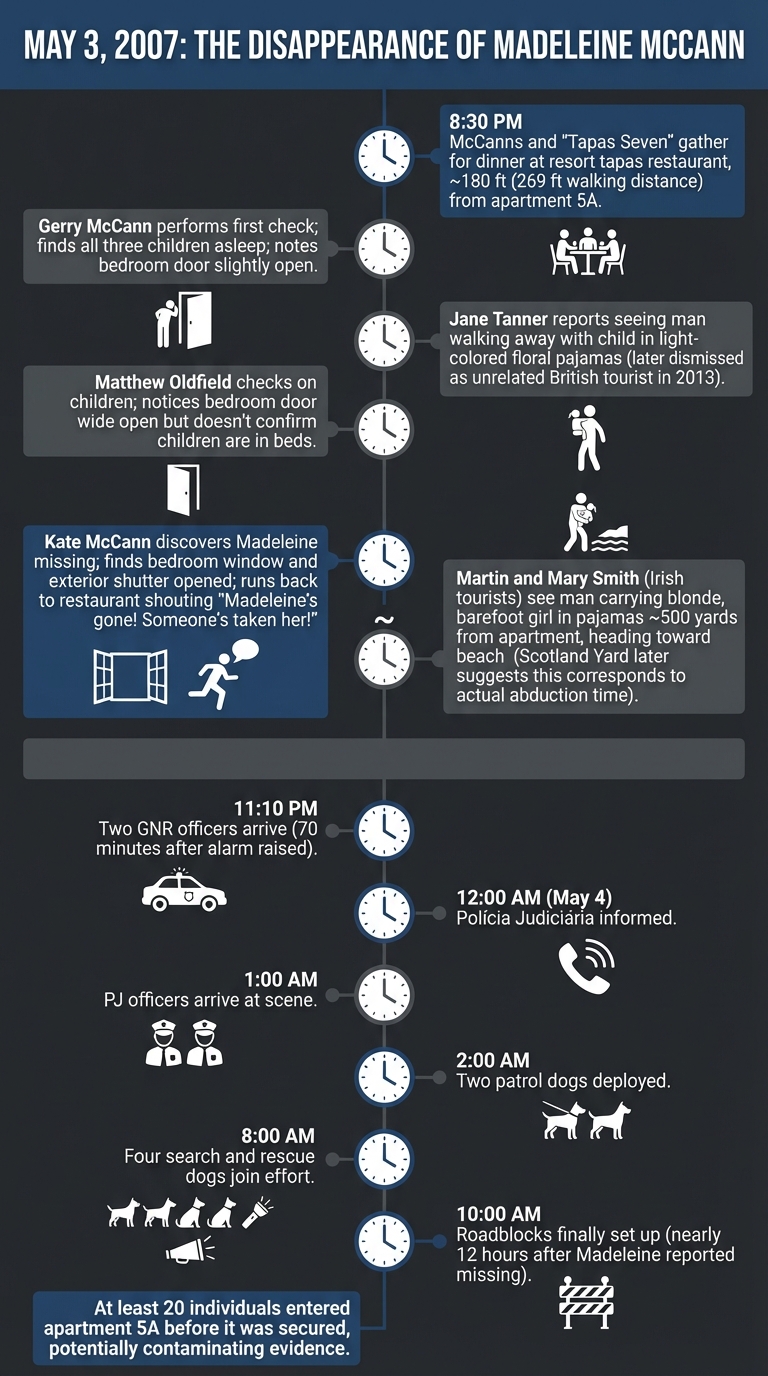
Timeline of Madeleine McCann Disappearance: May 3, 2007 Events
This night marked the beginning of a far-reaching investigation into the disappearance of Madeleine McCann.
Timeline of Events on May 3, 2007
Earlier that day, Madeleine reportedly asked her parents, "Why didn't you come when [my brother] and I cried last night?" This unsettling question raised concerns about a potential earlier intrusion into the apartment.
At 8:30 PM, the McCanns and their group of seven friends - later referred to as the "Tapas Seven" - gathered for dinner at the resort's tapas restaurant. The restaurant was about 180 feet away from apartment 5A, though the walking distance was closer to 269 feet. The group had arranged a system to take turns checking on their children throughout the evening.
9:05 PM: Gerry McCann performed the first check and found all three children asleep. He noted that the bedroom door was slightly open.
9:15 PM: Jane Tanner, one of the Tapas Seven, claimed she saw a man walking away from the apartment carrying a child dressed in light-colored floral pajamas. Years later, in 2013, Scotland Yard determined this man was an unrelated British tourist and dismissed the sighting.
9:30 PM: Matthew Oldfield, another member of the group, checked on the children. He noticed the bedroom door was wide open but did not confirm if the children were in their beds.
10:00 PM: Kate McCann returned to the apartment and discovered Madeleine was missing. She also noticed the bedroom window and its exterior shutter had been opened. Panicked, she ran back to the restaurant, shouting, "Madeleine's gone! Someone's taken her!"
Around this time, Irish tourists Martin and Mary Smith reported seeing a man carrying a blonde, barefoot girl in pajamas about 500 yards from the apartment, heading toward the beach. Scotland Yard later suggested this sighting likely corresponded to the actual time of the abduction.
As these events unfolded, the immediate response was hindered by delays and procedural missteps.
Initial Police Response
Two officers from the Guarda Nacional Republicana (GNR) arrived at the scene around 11:10 PM - approximately 70 minutes after Kate McCann raised the alarm. The Polícia Judiciária (PJ), Portugal's criminal police, were informed at midnight but did not arrive until 1:00 AM on May 4.
By this time, resort staff and guests had already begun searching the area. Two patrol dogs were deployed at 2:00 AM, and four search and rescue dogs joined the effort at 8:00 AM. However, roadblocks were not set up until 10:00 AM - nearly 12 hours after Madeleine was reported missing.
The initial investigation was marred by several critical oversights. At least 20 individuals entered apartment 5A before it was secured, potentially contaminating evidence. One officer was even seen dusting the bedroom window's exterior shutter for fingerprints without wearing gloves or protective gear. Additionally, descriptions of Madeleine were not promptly shared with border or marine police, and authorities failed to request motorway surveillance footage. Interpol did not issue a global missing-person alert until five days later.
The Early Investigation and Suspicions (2007-2008)
The investigation into Madeleine McCann's disappearance quickly became a whirlwind of forensic disputes, shifting narratives, and relentless media attention. These early developments not only shaped public perceptions but also deeply influenced the trajectory of the case.
The McCanns and Media Backlash
When Kate and Gerry McCann chose to hire professional PR consultants to keep Madeleine's story in the spotlight, it stirred tensions with Portuguese investigators. Many in law enforcement saw this media-driven approach as meddling. By March 2008, the McCanns faced a different battle: Express Newspapers settled a libel case, paying £550,000 in damages after publishing over 100 false claims accusing the couple of involvement in their daughter’s disappearance. The settlement also included rare, front-page apologies across four newspapers.
Forensic Clues and Initial Suspects
On May 15, 2007, Robert Murat, a British-Portuguese resident living near the resort, was named the first arguido (formal suspect). Despite a thorough search of his home, investigators found no evidence linking him to the case. Murat was officially cleared in July 2008 and later received £600,000 in libel damages for media accusations.
In August 2007, British sniffer dogs brought a new layer of intrigue when they detected traces of blood and cadaver scent in apartment 5A and in the Renault Scenic rental car hired by the McCanns weeks after Madeleine’s disappearance. Reports initially suggested a "100% DNA match" to Madeleine, but the UK’s Forensic Science Service later ruled the findings inconclusive. These ambiguous results only deepened the mystery, while suspicions began to shift toward the McCanns themselves.
The McCanns Declared "Arguidos"
On September 7, 2007, Portuguese police formally designated Kate and Gerry McCann as arguidos. Authorities pursued a theory that Madeleine had died in an accident within the apartment and that her parents staged an abduction to cover it up. During her interrogation, Kate McCann refused to answer 48 questions, later asserting that police were pressuring her to falsely confess to disposing of Madeleine’s body. Gerry McCann, however, remained resolute, stating:
"I'm confident of that [being eliminated from inquiries], because we have done nothing."
This tense chapter of the investigation led to calls for a deeper review of the case. By July 21, 2008, the Portuguese Attorney General archived the investigation due to insufficient evidence. The arguido status for both the McCanns and Robert Murat was lifted, and the exhaustive 30,000-page case file was made available to the public.
Operation Grange and Renewed Investigations (2011-2019)
Operation Grange: A Fresh Look at the Case
In May 2011, the Metropolitan Police launched Operation Grange, marking a shift from active searches in Portugal and the UK to a thorough case review. This initiative came at the urging of the McCanns, with Home Secretary Theresa May - backed by Prime Minister David Cameron - approving Scotland Yard’s involvement to reassess the case files.
Under the leadership of DCI Andy Redwood, the operation aimed to uncover new leads and bring clarity to the case. Over two years, the team meticulously reviewed more than 40,000 documents, which eventually led to fresh investigative directions. By July 2013, Operation Grange transitioned from a review to a formal investigation. By October of that year, Scotland Yard had identified 41 potential suspects. Investigators began working on the theory that Madeleine’s disappearance was the result of "a criminal act by a stranger", either through a planned abduction or a burglary gone wrong.
By September 2015, the operation’s cost had exceeded $12.5 million, climbing to approximately $15.4 million by April 2020. While these renewed efforts brought progress, they also highlighted the many challenges of solving the case.
Key Discoveries and Dead Ends
Operation Grange initially generated momentum, leading to some critical findings, but the case's complexity continued to pose difficulties. One major development occurred in 2013 when investigators ruled out the earlier Tanner sighting as a false lead. This shift allowed them to focus on the Smith sighting - a man seen carrying a child toward the beach around 10:00 PM - which became the more likely timeline for the abduction.
Despite these advances, significant obstacles remained. For example, Portuguese authorities had collected mobile phone records from Praia da Luz in 2007, but these records were never analyzed at the time. British investigators also faced friction with their Portuguese counterparts, who reportedly felt patronized by what they perceived as a "colonial power" attitude from the UK. Additionally, the crime scene from 2007 had been heavily compromised, with at least 20 people entering before it was secured, leaving little usable forensic evidence.
By October 2015, the investigative team was reduced from 29 officers to just four, and after examining over 600 individuals, they still struggled to identify a clear suspect. Meanwhile, Portuguese authorities reopened their own investigation in October 2013 to run parallel to Operation Grange. By 2017, cooperation between the two forces had reportedly improved significantly.
Throughout this period, the McCanns remained steadfast in their search for answers, stating:
"All we have ever wanted is to find her, uncover the truth and bring those responsible to justice."
The German Suspect and Recent Developments (2020-Present)
Christian Brückner's Identification as a Suspect
In June 2020, German authorities publicly identified Christian Brückner as the main suspect in the disappearance of Madeleine McCann. Brückner, a German national with a criminal history that includes 17 convictions for burglary, drug trafficking, and sex offenses, became the focus of a murder investigation. He had spent significant time in the Algarve region, near Praia da Luz, where Madeleine vanished in 2007.
Key evidence tying Brückner to the case includes phone records showing he received a call near the McCann family's apartment on May 3, 2007, the night Madeleine disappeared. Investigators also identified his yellow and white VW T3 Westfalia campervan near Praia da Luz, along with a linked Hotmail account that attracted suspicion.
Detective Titus Stampa of Germany's Federal Crime Police noted:
"I recall that the inbox was substantially cleared, with no records dating back to January 2007."
Brückner’s connection to the area was further highlighted by his 2005 conviction for raping a 72-year-old American woman at a villa near the McCann family's rental home. German Prosecutor Hans Christian Wolters shared his perspective on the case:
"It is my private opinion that the convicted rapist relatively quickly killed the girl, possibly abused her and then killed her."
In April 2022, Portuguese prosecutors officially named Brückner as an "arguido", or formal suspect, to ensure the case did not fall under the 15-year statute of limitations. Following the 2020 announcement, the Metropolitan Police received over 270 calls and emails from the public, shedding new light on the investigation.
Legal Proceedings and Current Status
The investigation gained momentum with large-scale search operations. In May 2023, authorities searched the Barragem do Arade reservoir, and in June 2025, German-led police conducted further searches near Brückner’s former residence between Praia da Luz and Lagos.
However, legal hurdles have complicated the case. In October 2024, Brückner was acquitted of unrelated sexual assault charges due to insufficient evidence. More significantly, in January 2025, prosecutors admitted they lacked the forensic evidence needed to charge him in connection with Madeleine's disappearance.
On September 17, 2025, Brückner was released from Sehnde prison in Germany after serving a seven-year sentence for the 2005 rape. Since his release, he has been under strict supervision, including wearing an electronic tag, surrendering his passport, and maintaining a fixed residence. A psychiatric evaluation concluded he remains a danger and could reoffend.
As of February 2026, the investigation remains active across Germany, Portugal, and the UK. In April 2025, the UK government approved over $120,000 in additional funding for Operation Grange, the ongoing effort to resolve the case.
Kate and Gerry McCann continue to hold onto hope, saying:
"We will never give up hope of finding Madeleine alive, but whatever the outcome may be, we need to know as we need to find peace."
Conclusion: Reflecting on Madeleine McCann's Case
It's been nearly 18 years since Madeleine McCann disappeared from a Portuguese resort, and her case remains unresolved. What began as a local search quickly expanded into a multi-national investigation, with costs exceeding $12 million by 2015 and an additional $120,000 allocated in April 2025.
This case revealed critical investigative failures that prompted changes in how missing children cases are handled. In October 2023, Portuguese police issued a formal apology to the McCanns, admitting that the initial investigation was mishandled and acknowledging that key forensic evidence may have been lost in the crucial early hours. The McCanns also endured immense public and media scrutiny, receiving $660,000 in libel damages from Express Newspapers as a result.
Despite setbacks, new leads have continued to surface. Christian Brückner, the primary suspect, was released from prison in September 2025 on unrelated charges, yet he remains a focus for investigators. Searches near his former residence in June 2025 and the three-day search of the Arade dam in May 2023 highlight the ongoing efforts to uncover the truth. International cooperation has also played a role, including the release of updated electronic facial identifications (e-fits) in 2013.
Kate and Gerry McCann's words capture their unwavering resolve:
"All we have ever wanted is to find her, uncover the truth and bring those responsible to justice."
Their determination serves as a reminder that the pursuit of answers continues.
At True Crime World (https://truecrime.world), we are committed to delivering accurate reporting and updates on Madeleine McCann's case and other significant investigations.
FAQs
What are the biggest unanswered questions from May 3, 2007?
The lingering questions from May 3, 2007, center on the mysterious disappearance of Madeleine McCann: Was she taken by someone, or did she leave on her own? Where could she possibly be now? Years of investigations and exhaustive searches have yet to uncover answers, leaving these haunting uncertainties unresolved.
Why did early police mistakes matter so much in this case?
Early errors by the police played a crucial role in the Madeleine McCann case. Delays in their initial response, not immediately notifying ports and borders, and mishandling the crime scene all contributed to significant setbacks. These mistakes likely led to lost evidence and slowed the investigation's momentum.
What evidence links Christian Brückner to Madeleine’s disappearance?
German prosecutors have pointed to evidence, such as cell phone data, indicating that Christian Brückner might have been in the vicinity when Madeleine McCann vanished. Despite this, he denies any involvement and has not been formally charged in relation to the case.