
Madeleine McCann Case: Lessons for Tourism Industry
How the 2007 disappearance reshaped resort security, childcare and cross-border alert systems, and changed family travel behavior.
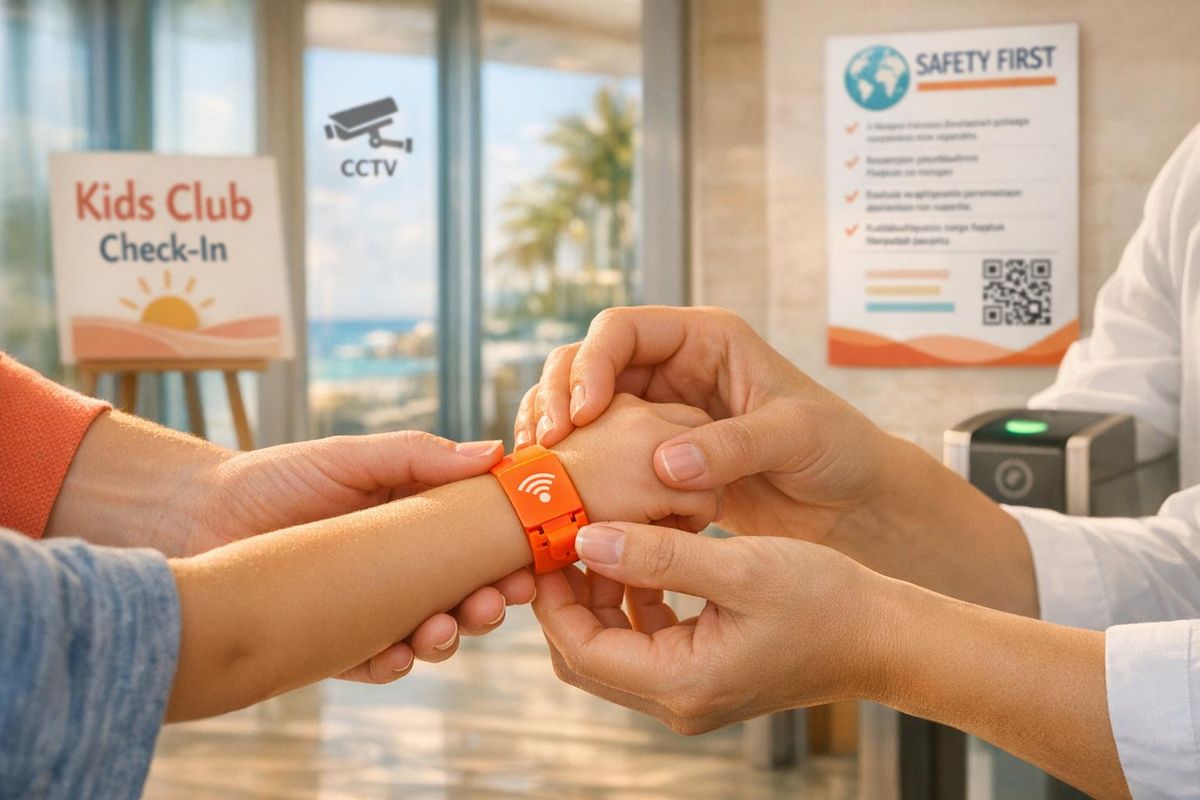
The disappearance of Madeleine McCann in 2007 highlighted critical gaps in child safety at resorts and reshaped global tourism. Resorts were forced to rethink security, childcare policies, and emergency protocols after this tragedy. Key takeaways include:
- Tourism Impact: Portugal's Algarve region saw a 30% drop in British holiday bookings, while other destinations gained popularity.
- Resort Security Changes: Gated perimeters, CCTV, and secure locking mechanisms became standard to prevent similar incidents.
- Child Safety Policies: Unsupervised childcare gave way to professional services, and staff training improved to handle emergencies effectively.
- Global Reforms: Unified alert systems, stricter crime scene protocols, and faster cross-border cooperation emerged to address missing children cases.
These changes show how one event can drive lasting improvements in safety standards across the tourism industry.
The Madeleine McCann Case: What Happened and What Went Wrong
Timeline of Events: Praia da Luz, May 3, 2007
On May 3, 2007, what began as a typical evening for the McCann family turned into a nightmare in Praia da Luz, Portugal. At 8:30 PM, Kate and Gerry McCann left their three children - Madeleine, age three, and her two-year-old twin siblings - sleeping in their ground-floor apartment (Apartment 5A) while they dined at the Ocean Club's tapas restaurant, about 180 feet (55 meters) away. To ensure the children’s safety, the group of adults had arranged a schedule to check on them every 30 to 40 minutes.
At 9:05 PM, Gerry McCann checked on the children and noticed that while they were asleep, the bedroom door was more open than he had left it. At 9:30 PM, family friend Matthew Oldfield also checked the apartment, but he did not visually confirm Madeleine’s presence. When Kate McCann returned at 10:00 PM, she found the bedroom door wide open, the window and exterior shutter ajar, and Madeleine gone. In shock, she reportedly shouted, "Madeleine's gone!"
Earlier that same day, Madeleine had asked her parents a chilling question: "Mummy, why didn't you come when we were crying last night?". This comment later led the McCanns to wonder if someone had entered the apartment the previous evening. These early moments were critical, but they also revealed weaknesses in both the family’s arrangements and the subsequent response.
Response Failures and Crime Scene Mishandling
The tragedy was compounded by a series of missteps and disorganized actions that hampered the investigation. After Madeleine’s disappearance was discovered, the Ocean Club activated its missing-child protocol at 10:30 PM. Around 60 staff members and guests joined an uncoordinated search that lasted until 4:30 AM. Unfortunately, this effort unintentionally disturbed potential evidence, as many people entered Apartment 5A before it was secured.
Local police (GNR) arrived at the scene at 11:10 PM, but criminal investigators from the Polícia Judiciária (PJ) didn’t show up until after 1:00 AM. Forensic practices were poorly executed - one officer was seen dusting the exterior shutter for fingerprints without gloves or protective clothing. Crucial steps, like setting up roadblocks, were delayed until 10:00 AM the next day, nearly 12 hours after Madeleine’s disappearance. Authorities also failed to promptly notify border and marine police or request highway surveillance footage from Euroscut, which monitored roads leading to the Spanish border. It took an astonishing five days for Interpol to issue a global missing-person alert.
Reflecting on these failures, Olegário de Sousa, Chief Inspector of the Polícia Judiciária, remarked:
"Key forensic evidence was likely lost due to inadequate scene protection".
In October 2023, Portuguese police issued a formal apology to the McCanns. They admitted that protocols for missing children in 2007 were insufficient and acknowledged the additional challenges the McCanns faced as foreigners in an unfamiliar country. These failings have since influenced global changes in child safety measures within the tourism industry.
sbb-itb-ade15ac
Ep. 15 – The 3-Year-Old Who Vanished in Portugal: Madeleine McCann
How the Tourism Industry Changed Child Safety Protocols
The tragic case of Madeleine McCann in 2007 exposed glaring weaknesses in how resorts safeguarded children. Before this incident, many family-oriented vacation spots offered minimal security. Simon Calder, Travel Editor at The Independent, highlighted the relaxed approach at the time:
"You don't get the high fences that you might find in some other resorts with security guards, simply because nobody would imagine you would ever need them".
This complacent mindset shifted significantly after Madeleine's disappearance, leading to sweeping changes in resort safety protocols.
Improved Monitoring and Surveillance in Resorts
Resorts moved away from open layouts to more secure environments, incorporating gated perimeters and controlled entry points. These changes made it easier to monitor movement and spot unauthorized individuals. Surveillance systems also became a priority after it was revealed that highway footage wasn't requested during the critical hours following Madeleine's disappearance. Today, resorts rely on extensive CCTV networks covering entrances, exits, and common areas, ensuring footage is readily available during emergencies.
Another major shift involved guest privacy. In 2007, some resorts used public message books at reception desks, inadvertently disclosing sensitive details like which rooms had unattended children. This practice has been eliminated, with strict confidentiality policies now in place to protect guest information from potential misuse.
Required Staff Training on Child Safety
While better surveillance strengthens security, well-trained staff are essential for handling emergencies effectively. The chaotic response on May 3, 2007, exposed serious flaws in staff preparedness. The uncoordinated search efforts led to contamination of the crime scene, with multiple individuals entering the apartment and possibly destroying crucial DNA evidence.
Modern training programs now prioritize crime scene preservation. Staff are trained to secure the area immediately before coordinating search efforts, addressing the mistakes of 2007 when evidence was compromised. Emergency response protocols have also been standardized, ensuring authorities are notified without delay and search operations begin promptly. Additionally, the five-day delay in issuing Interpol's global missing-person alert back in 2007 has prompted the adoption of rapid escalation procedures across the industry.
New Family-Oriented Policies in Vacation Rentals
Resorts have introduced family-friendly policies to further enhance child safety. One major improvement has been the shift toward supervised childcare options. Instead of relying on periodic parental checks, many resorts now offer "dining-out" creche services. These allow parents to enjoy their meals while children are cared for by qualified professionals in secure, central locations. Simon Calder explained:
"It is a very relaxed, very British-focused place, English-speaking staff - many of them have professional child-care qualifications".
This approach replaces unsupervised childcare practices, providing peace of mind for families.
Physical security in accommodations has also improved. In 2007, Apartment 5A had patio doors and window shutters that could only be locked from inside, creating vulnerabilities. Today, vacation rentals are required to have secure locking mechanisms for all entry points, including windows and shutters. Additionally, check-in procedures now include safety briefings where staff review childcare options, emergency protocols, and locking mechanisms. These efforts aim to discourage parents from leaving children unattended by offering safer alternatives.
| Protocol Area | 2007 Observations/Failures | Modern Industry Standard |
|---|---|---|
| Supervision Method | Periodic parental checks | Supervised creches with qualified staff |
| Physical Security | Low fences, open public access | High fences, gated access, security guards |
| Guest Privacy | Public message books | Confidentiality regarding child locations |
| Emergency Response | Delayed alerts, uncoordinated efforts | Immediate action, standardized protocols |
Media Coverage and Its Effect on Travel Behavior
The disappearance of Madeleine McCann became one of the most widely reported missing-person cases in modern history, with the website findmadeleine.com receiving a staggering 58 million hits in just two days. This intense media attention had a profound impact on how families perceived vacation safety.
How the Case Affected Tourism in the Algarve Region
Tourism in Portugal took a noticeable hit. Bookings to the country dropped significantly, while Spain saw a 20% decline in its own bookings. Meanwhile, destinations like Turkey, Egypt, and Tunisia experienced a surge in popularity as families sought alternative vacation spots. Journalist Sarah Gordon from the Daily Mail highlighted this shift, stating, "The 'Madeleine McCann Effect' is still hitting holiday bookings to Portugal more than two years after the little girl disappeared there."
The Algarve, where tourism supports around 60% of the local population, felt the brunt of this downturn. The Portuguese Economy Minister, Manuel Pinho, even canceled the "Allgarve" promotional campaign - a multi-million euro effort led by football manager José Mourinho - out of concern that marketing the region during the investigation would appear insensitive.
British travel company Mark Warner also suffered financially, reporting a loss of approximately $3.6 million on a $60 million turnover for the fiscal year ending October 2007. Despite introducing enhanced security measures to reassure parents, the company struggled to recover and eventually withdrew from the Ocean Club resort in January 2015. These shifts in tourism patterns marked the beginning of new international vacation trends.
Changes in International Family Vacation Trends
The widespread media coverage not only affected where families chose to travel but also changed how they approached vacations. In Praia da Luz, for instance, parents began taking their children with them to restaurants and avoided going out in the evenings.
The case also led many families to reconsider leaving their children in unsupervised childcare. Manny Fontanela-Novoa, CEO of Thomas Cook, expressed optimism about Portugal's ability to bounce back, saying, "Portugal is very much a family destination and I think it will come back." However, the recovery was slow, and some areas have yet to reach the levels of popularity they enjoyed before 2007. While resorts improved their safety protocols, families also adjusted their vacation habits to prioritize their children's well-being.
Global Safety Reforms After High-Profile Disappearances
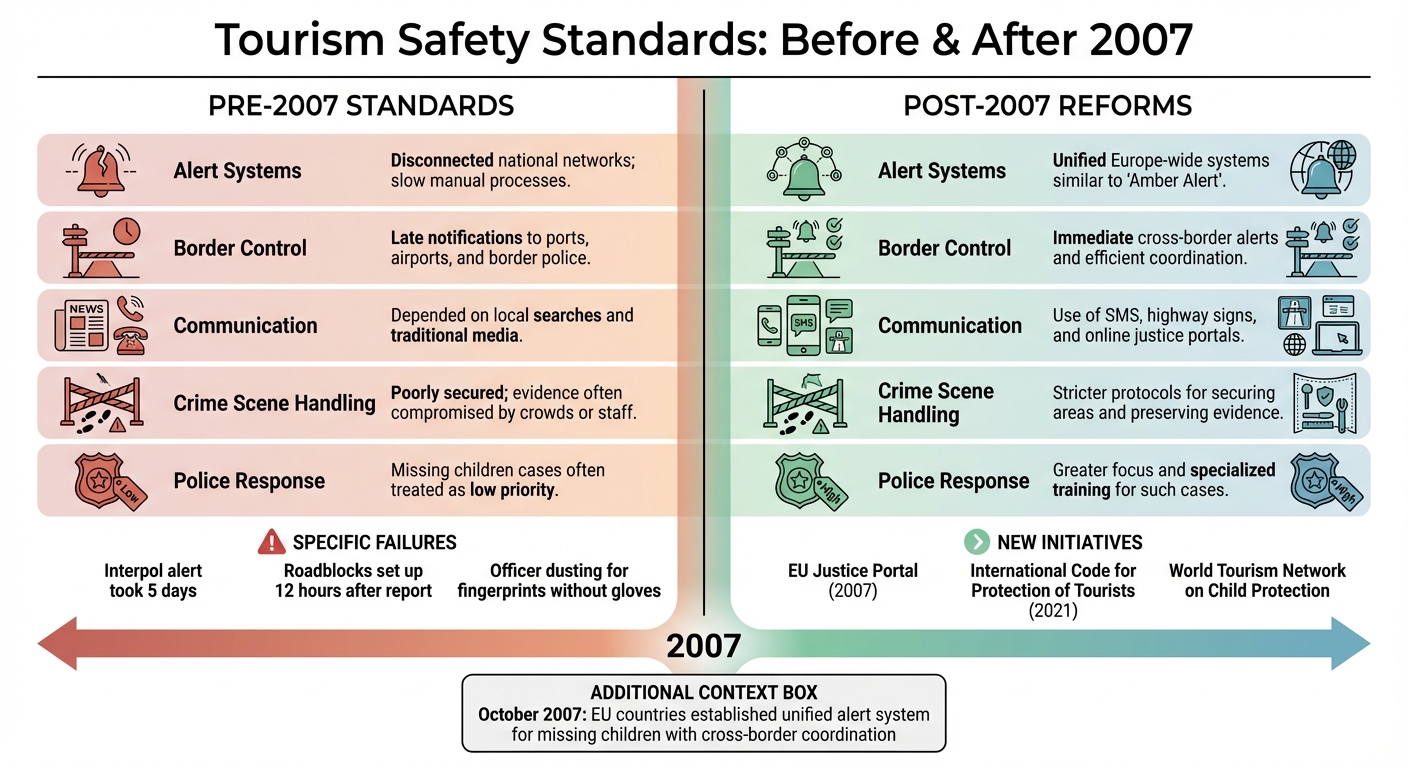
Tourism Safety Standards Before and After Madeleine McCann Case 2007
The disappearance of Madeleine McCann highlighted serious flaws in child safety protocols, leading to sweeping reforms across Europe. These early missteps became the catalyst for a global rethinking of how child safety is addressed in tourism.
Pre-2007 vs. Post-2007 Tourism Safety Standards
Before 2007, the response to missing children in tourist areas was slow and disorganized. For example, Interpol took five days to issue a global alert when Madeleine went missing, and roadblocks were not set up until 12 hours after the initial report - critical time was lost. Notifications to border and marine authorities were also significantly delayed.
Crime scene management was another glaring issue. In one case, an officer was reportedly dusting for fingerprints without gloves or protective clothing, compromising potential evidence.
By October 2007, these shortcomings pushed EU countries to establish a unified alert system for missing children. This system connected national networks, allowing for faster and more coordinated responses. Portuguese Justice Minister Alberto Costa stressed the need for immediate action:
"We need a flexible, rapid-response system that triggers swift coordination."
The new measures included cross-border alerts that could be triggered instantly if there was a suspicion that a child might be moved to another country. Digital tools like SMS alerts and electronic highway signs were introduced to speed up communication. Additionally, the EU launched a central Justice Portal, making information about missing children accessible across borders.
| Feature | Pre-2007 Standards | Post-2007 Reforms |
|---|---|---|
| Alert Systems | Disconnected national networks; slow manual processes | Unified Europe-wide systems similar to "Amber Alert" |
| Border Control | Late notifications to ports, airports, and border police | Immediate cross-border alerts and efficient coordination |
| Communication | Depended on local searches and traditional media | Use of SMS, highway signs, and online justice portals |
| Crime Scene Handling | Poorly secured; evidence often compromised by crowds or staff | Stricter protocols for securing areas and preserving evidence |
| Police Response | Missing children cases often treated as low priority | Greater focus and specialized training for such cases |
These changes laid the groundwork for broader international efforts to address child safety.
Missing Child Protocols Adopted Worldwide
The challenges exposed in Praia da Luz spurred global action. The United Nations Tourism body (formerly UNWTO) founded the World Tourism Network on Child Protection to unite governments, NGOs, and the travel industry in combating exploitation, trafficking, and disappearances.
In December 2021, the International Code for the Protection of Tourists (ICPT) was introduced, setting global minimum standards for safeguarding tourists during emergencies. This framework emphasized prevention, information sharing, and coordinated assistance. It has since become a benchmark for improving safety protocols worldwide.
The UK’s ongoing commitment to the McCann investigation also underscored the importance of international collaboration. By September 2015, the British government had allocated over $10,000,000 to Operation Grange, and in April 2025, an additional $100,000 was granted to Scotland Yard to continue their work. Such sustained cooperation among international police forces was rare before 2007.
These reforms have reshaped the tourism industry’s approach to child safety. Today, many resorts have formal protocols for locating missing children, and staff are trained to act immediately during the critical "golden hour" after a disappearance. This proactive focus marks a significant shift from the reactive measures of the past.
Conclusion: What the Tourism Industry Learned
The events in Praia da Luz served as a wake-up call for the tourism industry, leading to a complete reevaluation of child safety practices. The case underscored the importance of having immediate missing-child protocols, maintaining secure crime scenes, and implementing rapid alert systems. These lessons prompted widespread and lasting reforms within the sector.
The financial repercussions made it clear just how exposed the industry is to safety failures. The fallout highlighted that poor safety measures aren't just ethical missteps - they carry serious commercial risks. This reality pushed resorts to rethink their operations and implement stricter safety measures.
One of the most notable changes was the move away from informal childcare arrangements. Resorts began prioritizing professional, on-site childcare services, effectively eliminating the risk of leaving children unsupervised. As David Hopkins, Managing Director of Mark Warner, put it:
"Our security is terribly robust."
Safety audits became a regular practice, targeting physical vulnerabilities, while staff received training in preserving crime scenes to ensure they remain untouched until law enforcement takes over.
On a broader scale, international safety protocols were revamped, reinforcing the idea that even a single lapse can have industry-wide consequences. From upgraded alert systems to stronger international collaboration, these reforms have fundamentally changed how the tourism sector approaches child safety. The message is clear: constant vigilance and improvement are non-negotiable if the industry is to avoid repeating past mistakes.
FAQs
What major child-safety upgrades did resorts implement after 2007?
Resorts implemented several child-safety measures after 2007, such as installing locks on patio doors that can only be secured from the inside, adding child-safety gates to stairways, and improving overall safety protocols. These adjustments were shaped by the lessons learned from the Madeleine McCann case and its influence on the tourism sector.
How should a resort respond in the first hour a child is reported missing?
When a critical situation arises, such as a missing child, a resort must act swiftly and decisively. The first priority is to launch an emergency response, which includes notifying all staff, securing the area, and immediately contacting local law enforcement.
Key actions include:
- Collecting vital details: Note the child’s last known location, physical description, and any distinguishing features.
- Activating emergency protocols: Resorts should have predefined procedures for such incidents, ensuring a coordinated and efficient response.
- Reassuring guests: Keeping guests informed and calm is essential to maintain order during a high-stress situation.
Collaboration with authorities is another critical step. This might involve sharing surveillance footage, providing witness statements, or handing over any other evidence that could aid the investigation. These actions not only support the search but also help ensure the safety and trust of all guests.
What can parents do to reduce child-safety risks while traveling?
Parents can minimize safety risks for their children while traveling by following a few straightforward steps. Always double-check that doors and windows are locked securely, particularly when kids are asleep. In unfamiliar settings, consider using child safety gates for stairs to prevent falls. Additionally, keep a close eye on children during check-ins or in areas that might pose potential dangers. Staying alert and aware of your surroundings can go a long way in ensuring a safe and worry-free trip with your little ones.