
Madeleine McCann: Accidental Events in Disappearance
Four accidental scenarios—sedation, wandering, burglary or hit-and-run—are examined to explain a long-unsolved child disappearance, weighing evidence, flaws, and modern forensic leads.

Madeleine McCann's 2007 disappearance remains unsolved, with theories ranging from abduction to accidental events. While the official narrative leans toward abduction, alternative explanations suggest accidents involving sedation, wandering off, burglary, or a hit-and-run. Each theory has evidence and challenges, but none have led to definitive answers.
Key points:
- Sedation Overdose: Sniffer dogs alerted to cadaver and blood scents, but DNA evidence was inconclusive.
- Wandering Toddler: Madeleine may have exited the apartment and faced hazards like wells or construction pits, yet searches found no remains.
- Burglary Gone Wrong: High burglary rates in the area suggest intruders panicked, but no valuables were stolen.
- Hit-and-Run: A driver may have accidentally struck and hidden her, though no forensic evidence supports this.
Early investigation errors, like delayed roadblocks and scene contamination, complicated the case. Despite advanced forensic methods and renewed searches, the truth remains elusive. Modern tools may still provide insights into this nearly two-decade-old mystery.
Madeleine McCann: The hit-and-run theory explained
The Sedation Overdose Theory
The sedation overdose theory proposes that Madeleine McCann died accidentally due to parental sedation. This idea gained momentum following forensic alerts in Apartment 5A on the night of May 3, 2007, and observations about the behavior of those involved.
Evidence Cited for This Theory
Two British sniffer dogs played a key role in fueling this theory. Eddie, trained to detect cadaver scents, and Keela, trained to detect blood, alerted investigators to certain areas connected to the McCanns. Eddie signaled behind a sofa in Apartment 5A, while both dogs alerted to the boot and key fob of a Renault Scenic hired by the McCanns 24 days after Madeleine’s disappearance. Portuguese police also pointed to DNA evidence found in the car boot, which included 15 out of 19 components matching Madeleine's DNA. This became a significant factor in naming Kate and Gerry McCann as formal suspects (arguidos) in September 2007.
Another point of concern was the behavior of Madeleine's younger siblings, Sean and Amelie, during the events of that night. Witnesses observed that the twins did not wake up during the frantic search and remained asleep even when moved to another apartment in the cold night air. Their deep sleep suggested a state of heavy sedation (Level 6 on the Ramsay Sedation Scale). Critics also noted Kate McCann’s medical background in anesthetics, suggesting she might have had the expertise to administer sedatives. Further suspicion arose when Kate declined to answer 48 specific questions during her police interrogation, including those concerning the children's medication.
However, subsequent forensic investigations cast doubt on the validity of this theory.
Counterarguments and Official Findings
Forensic analysis ultimately undermined the sedation theory. John Lowe, a forensic scientist from the Forensic Science Service, described the DNA evidence from the rental car as "too complex for meaningful interpretation." He explained that the DNA components were not unique to Madeleine and could have resulted from chance matches or contamination. Additionally, upon their return to the UK, Kate and Gerry McCann voluntarily provided hair samples for drug testing. These tests, which covered the period of their vacation, came back negative for sedatives or anti-depressants [[13]](http://madeleinemythsexposed.pbworks.com/w/page/41993456/The Calpol Myth).
The McCanns consistently denied giving their children anything stronger than standard Calpol, a paracetamol-based pain reliever without sedative properties [[13]](http://madeleinemythsexposed.pbworks.com/w/page/41993456/The Calpol Myth). Claims that Calpol could have sedative effects were also discredited, as Calpol Night - a version containing a mild sedative - was only introduced in September 2007, months after Madeleine’s disappearance [[13]](http://madeleinemythsexposed.pbworks.com/w/page/41993456/The Calpol Myth). In July 2008, Portuguese authorities dismissed the sedation theory due to insufficient evidence and lifted the McCanns' arguido status. Gerry McCann called the allegations "ludicrous".
While the sedation theory initially raised questions, forensic findings ultimately discredited it, leading investigators to explore other accidental scenarios.
The Wandering Toddler Accident Theory
The wandering toddler theory proposes that Madeleine woke up during the night, left the apartment on her own, and tragically suffered a fatal accident nearby. This idea gained traction because the sliding patio doors of Apartment 5A, while closed, were left unlocked to make it easier for her parents to check on the children while dining at the Tapas restaurant. Madeleine was familiar with the area. Earlier that morning, she had asked her parents, "Why didn't you come when we cried last night?" - a comment suggesting she had been awake and possibly searching for them the previous evening.
When her disappearance was reported at 10:30 PM, 60 staff and guests immediately joined the search, initially assuming she had wandered off. The apartment was approximately 180 feet from the restaurant in a straight line and about 269 feet if following the public street. Investigators speculated that in the dark, a child might naturally be drawn toward the lights and noise coming from the pool and restaurant area where her parents were dining. This theory highlights potential dangers in the resort's surroundings.
Hazards Around the Ocean Club Resort

The unlocked patio door meant Madeleine could have easily exited the apartment, exposing her to various hazards around the Ocean Club Resort. At the time, the resort was under development, with building sites, ditches, and storm drains scattered around. One particularly concerning hazard was a large roadworks pit near the apartment, which was filled in the morning after she disappeared. Sky News reported:
One theory is that Madeleine woke up and went looking for her parents, opened the unlocked patio doors and walked out of the apartment, down the hill and fell into a big roadworks pit. The theory is that she either died or was knocked unconscious and was not spotted when the hole was filled the next morning.
Other risks included disused wells, caves, and ruins. The coastline, located 984 feet away, posed additional dangers with its steep downhill terrain. Poorly lit roads in the area raised fears of a hit-and-run accident. According to The Week:
Others suggest that the toddler was struck by a car as she wandered along the poorly lit roads, and that the panicked driver removed the body and dumped it elsewhere to cover their tracks.
These hazards underscored the need for a detailed and thorough forensic search.
Investigative Methods to Test This Theory
To explore this theory, investigators conducted targeted searches using advanced forensic tools. On the night of Madeleine's disappearance, two patrol dogs were deployed at 2:00 AM, followed by four search and rescue dogs the next morning at 8:00 AM. Police searched local waterways, wells, caves, sewers, and ruins.
In June 2025, German and Portuguese authorities carried out a three-day forensic search in the Atalaia region near Lagos, costing approximately $375,000. The operation included ground-penetrating radar to examine abandoned farm buildings and wells. Forensic teams recovered bone fragments and pieces of clothing, which are still being analyzed in German labs. Earlier, in May 2023, a search at the Arade Dam yielded unnamed objects that were later deemed inconclusive after forensic evaluation.
The Burglary Gone Wrong Theory
This theory suggests that intruders broke into Apartment 5A intending to commit a burglary but panicked when Madeleine woke up, leading to her abduction or death. Unlike planned kidnappings, this scenario hinges on a burglary that spiraled out of control. The Metropolitan Police's Operation Grange classified Madeleine's disappearance as "a criminal act by a stranger," with a "burglary gone wrong" cited as the most plausible explanation. The apartment's layout made it particularly vulnerable, with two accessible sides and unlocked rear patio doors . Investigators also considered the possibility that an intruder may have seen a note in the resort's swimming-pool reception book, which mentioned that the children were asleep in the apartments while their parents dined nearby. This theory is further supported by a spike in burglary incidents in the area around that time.
Burglary Activity in the Area Before the Disappearance
Before May 2007, Praia da Luz experienced a sharp increase in burglaries - four times the usual rate . British police reviewed 18 break-ins across Algarve villas that could be connected, with three occurring in Praia da Luz specifically. Disturbingly, nine of these incidents involved alleged sexual assaults on British girls aged six to 12. One such assault, targeting a 10-year-old girl in 2005, happened in the "heart of Praia da Luz," alarmingly close to where Madeleine disappeared. Detective Chief Inspector Andy Redwood highlighted the significance of this proximity:
Clearly the fact that we've now got an assault that is in the heart of Praia da Luz, very close to where a previous matter had been reported, means that we are even more interested in this as part of the inquiry.
Witness accounts described a suspect as a tanned man with dark hair, often bare-chested, with a "pot belly" and a "noticeable odor." Two families also recalled him wearing a distinctive burgundy long-sleeved top.
Problems with the Burglary Theory
Despite its plausibility, this theory faces serious challenges. Critics argue that key elements don't align with typical burglary behavior. Carlos Anjos, former head of the Portuguese Police Officers' Union, dismissed the idea as far-fetched, pointing out that no valuables were reported stolen - only a child was missing . The absence of theft is unusual for a burglary scenario. Sky News Crime Correspondent Martin Brunt also questioned the theory:
Such a spontaneous act is likely to lead to mistakes, a trail of evidence and detection.
Yet, forensic teams found no trace of Madeleine despite extensive searches. The investigation was further hampered by procedural missteps - around 20 people entered the apartment before it was secured, and crowds gathered outside the bedroom window, potentially destroying critical evidence. These inconsistencies make it difficult to fully support the idea of a burglary gone wrong as the definitive explanation for Madeleine's disappearance.
The Hit-and-Run Accident Theory
This theory suggests that Madeleine may have woken up, exited her apartment through an unlocked patio door, and wandered toward nearby roads, where she was struck by a vehicle. The driver, possibly under the influence, may have panicked and hidden her body to avoid facing legal consequences. Unlike theories involving medication or burglary, this scenario revolves around a vehicular accident, adding another dimension to accidental explanations in Madeleine's disappearance.
Circumstances That Support This Theory
Investigators have examined the actions of a German restaurant worker and her British chef partner, both connected to serving the McCanns on the night Madeleine vanished. In 2018, the British man’s sister claimed his alcoholism was tied to his wife’s alleged involvement in a hit-and-run incident involving Madeleine.
A neighbor reported overhearing an intense argument on May 4, 2007, during which the British man appeared visibly upset while arguing with his German wife. Additionally, a witness told police in 2007 that they had seen a woman with a young girl in a car resembling one linked to the German woman under investigation. Reports from the Policia Judiciaria suggested the possibility that this woman could have accidentally struck Madeleine and then acted out of panic.
Kate McCann has dismissed this theory, arguing that it would be unlikely for a three-year-old to navigate multiple doors and gates to reach the road. However, other reports indicate that Madeleine woke up crying the night before her disappearance and asked her parents where they had been, hinting that she may have been capable of seeking them out.
These details bring attention to the potential role of a vehicle in Madeleine's case and raise questions about investigative gaps.
Gaps in the Investigation and Recommended Next Steps
Efforts to investigate this theory hit roadblocks when German courts declined a request for an undercover operation. Portuguese authorities had sought approval to deploy an undercover officer to build trust with the German woman under suspicion and potentially secure a confession, but this strategy was rejected. Following this, resources were redirected toward Christian Brueckner, who became the main suspect in 2020.
Several investigative avenues remain unexplored. Authorities could review local traffic and car rental records from May 2007 to identify vehicles that might have been repaired or returned with unexplained damage. Forensic searches of scrapyards in the Praia da Luz area could also uncover evidence of vehicles linked to residents or workers from that time. Additionally, German investigators have requested access to data from SIM cards used in 2007, which might reveal critical location and movement patterns. While German prosecutors hold over 20,000 pages of evidence related to the broader investigation, much of it has shifted away from this particular theory.
Comparison of Accidental Theories
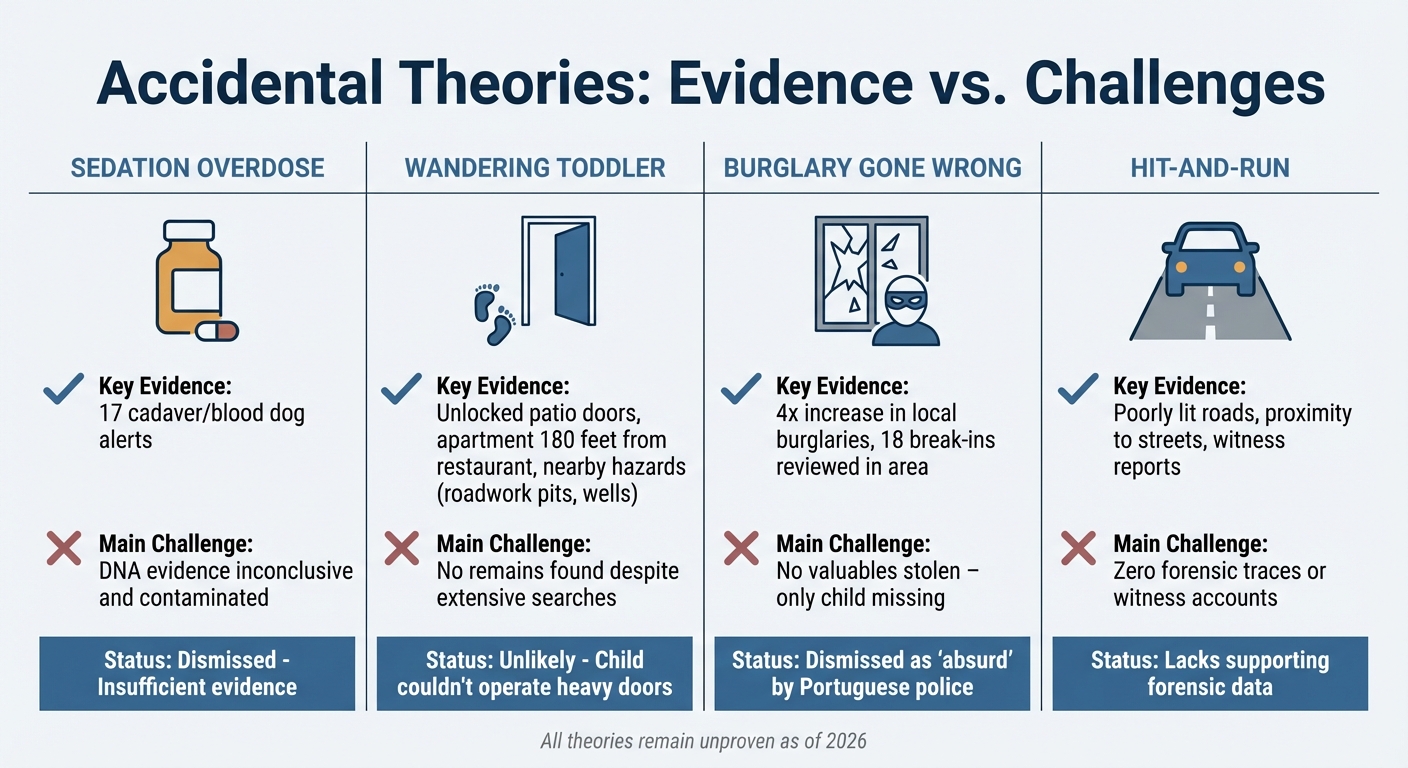
Comparison of Four Accidental Theories in Madeleine McCann Disappearance
Strengths and Weaknesses of Each Theory
The accidental theories surrounding Madeleine McCann's disappearance each bring their own evidence and investigative hurdles. For instance, the sedation overdose theory hinges on 17 cadaver and blood dog alerts. However, the DNA evidence tied to this theory was deemed inconclusive and contaminated [[20]](http://madeleinemythsexposed.pbworks.com/w/page/55163729/Abduction Theories).
The burglary gone wrong theory, while noting a fourfold increase in local burglaries prior to May 2007, struggles to explain why no valuables were taken from the apartment. Carlos Anjos, President of the Portuguese Police Officers' Union, dismissed this theory outright, stating, "not even a wallet disappeared, no television disappeared, nothing else disappeared. A child disappeared".
The wandering toddler theory presents physical challenges, as it’s unlikely a nearly four-year-old could manage heavy curtains and patio doors without leaving evidence. Journalist Mark Williams-Thomas speculated, "I think Maddie was aware they were in the tapas bar in the resort... I believe she woke up and went looking for them, she left the apartment and came out". Despite extensive searches of nearby hazards like roadwork pits and wells, no remains were found. Meanwhile, the hit-and-run theory fails to hold up due to a lack of any forensic evidence or eyewitness accounts.
| Theory | Key Evidence | Main Challenge | Reason for Dismissal |
|---|---|---|---|
| Sedation Overdose | 17 cadaver/blood dog alerts | DNA evidence was inconclusive and contaminated [[20]](http://madeleinemythsexposed.pbworks.com/w/page/55163729/Abduction Theories) | Insufficient evidence; improbable cover-up [[20]](http://madeleinemythsexposed.pbworks.com/w/page/55163729/Abduction Theories) |
| Wandering Toddler | Unlocked doors and nearby hazards | No remains found in searched areas | Unlikely a child would operate and close heavy doors |
| Burglary Gone Wrong | Fourfold increase in local burglaries | No valuables were stolen from the apartment | Dismissed as "absurd" by Portuguese police |
| Hit-and-Run | Proximity to roads and a potential panic scenario | Zero forensic traces or witness accounts | Lacks supporting forensic data |
These challenges underscore the complexities of each theory and the need for more advanced investigative methods.
Using Modern Forensics to Reassess Accidental Scenarios
Given the unresolved questions, modern forensic tools could offer new insights. Advances in DNA analysis now allow for the processing of smaller and more degraded samples than was possible in 2007. This could help clarify previous uncertainties. For example, during a June 2025 search in the Atalaia region, investigators used ground-penetrating radar to recover bone and clothing fragments, which are still undergoing laboratory evaluation.
Additionally, retesting the "stranger" DNA sample collected during the June 2007 bedroom search with high-sensitivity kits could provide more definitive results. Geospatial mapping paired with ground-penetrating radar could also help systematically investigate previously unsearched areas like wells, storm drains, and construction voids around the Ocean Club Resort. Behavioral analysis of the 2007 canine forensic films could shed light on whether handler cues influenced the dog alerts.
Finally, the transition from Portugal’s box-based filing system to Britain’s HOLMES 2 database has significantly improved the ability to cross-reference leads. This technological improvement exemplifies how modern tools can reshape cold case investigations, offering hope for resolving lingering questions about accidental scenarios.
Conclusion
The theories about Madeleine McCann's disappearance have influenced the investigation for nearly two decades, creating friction between Portuguese and British authorities and shaping how resources have been used. While the Polícia Judiciária initially focused on the parents after cadaver dogs raised alerts, British investigators under Operation Grange - an effort that has cost over $17 million as of 2026 - centered their efforts on the possibility of a stranger abduction. This divide underscores a deep disagreement in how the evidence has been interpreted.
Each accidental theory faces significant evidentiary hurdles. From inconclusive DNA results to questionable scenarios about Madeleine's mobility and the crime scene's condition, none have held up under scrutiny. Portuguese officer Carlos Anjos even called the burglary theory "absurd".
Missteps in the early stages of the investigation made things worse. Before forensic teams could secure the scene, around 20 people had already contaminated it. Roadblocks weren’t set up until 10:00 AM the next morning, costing investigators critical time. These early errors have made it even more important to rely on modern techniques today.
Advances in forensic science offer a glimmer of hope. In June 2025, a search in the Atalaia region - at a cost of roughly $300,000 - used ground-penetrating radar to examine abandoned wells and structures. This effort uncovered bone and clothing fragments, now being analyzed in Germany. Today’s high-sensitivity DNA testing can work with smaller and more degraded samples than what was possible in 2007, potentially shedding light on unresolved questions.
With prime suspect Christian Brueckner released from prison in September 2025 and forensic results still pending, the case remains open. Whether the truth points to an accident or a crime, solving Madeleine McCann's disappearance will demand a thorough, evidence-based reevaluation of every theory.
FAQs
What early investigation mistakes most damaged the evidence?
One major misstep in the early stages of the investigation was the delay in sealing off the crime scene until the following morning. This allowed contamination, which could have significantly impacted the integrity of the evidence. Another critical error was the failure to send Madeleine’s bedding for forensic analysis. These oversights likely jeopardized essential evidence, such as fibers, fingerprints, or DNA, that could have been pivotal in understanding what happened.
Why were the cadaver and blood dog alerts not considered proof?
The alerts from cadaver and blood dogs were not accepted as proof because they aren't legally admissible in criminal trials. Moreover, such alerts don't always align with physical evidence, which brings their reliability into question as conclusive evidence.
What modern forensic tests could still produce new leads today?
Modern forensic techniques hold the potential to breathe new life into cold cases. For instance, advanced DNA analysis can reexamine biological evidence like blood or hair, often revealing details that older methods might have missed. Another intriguing tool is reverse speech analysis, which could provide fresh perspectives by analyzing speech patterns for hidden meanings or clues. By applying these updated technologies to existing evidence, investigators may uncover critical details that were previously overlooked.