
JonBenét Ramsey Case: Police Errors Explained
Early crime-scene failures, delayed interviews and mishandled evidence compromised an iconic child homicide investigation and left it unsolved.
When JonBenét Ramsey's body was discovered on December 26, 1996, the investigation was marred by critical missteps that still hinder the case today. From failing to secure the crime scene to delaying witness interviews, these errors compromised evidence and complicated efforts to solve the case. Key mistakes included:
- Unsecured Crime Scene: The house was left open to contamination, with friends and family moving freely, disturbing potential evidence.
- Delayed Witness Interviews: Police didn’t separate or formally question JonBenét’s parents immediately, allowing time for legal defenses to form.
- Mishandling Evidence: JonBenét’s body was moved multiple times, destroying forensic details and contaminating evidence.
- Ransom Note Mismanagement: Improper handling of the note erased potential fingerprints and trace DNA.
These failures highlight the importance of crime scene protocols, timely interviews, and collaboration with expert agencies. Despite advancements in forensic science, the case remains unsolved nearly three decades later.
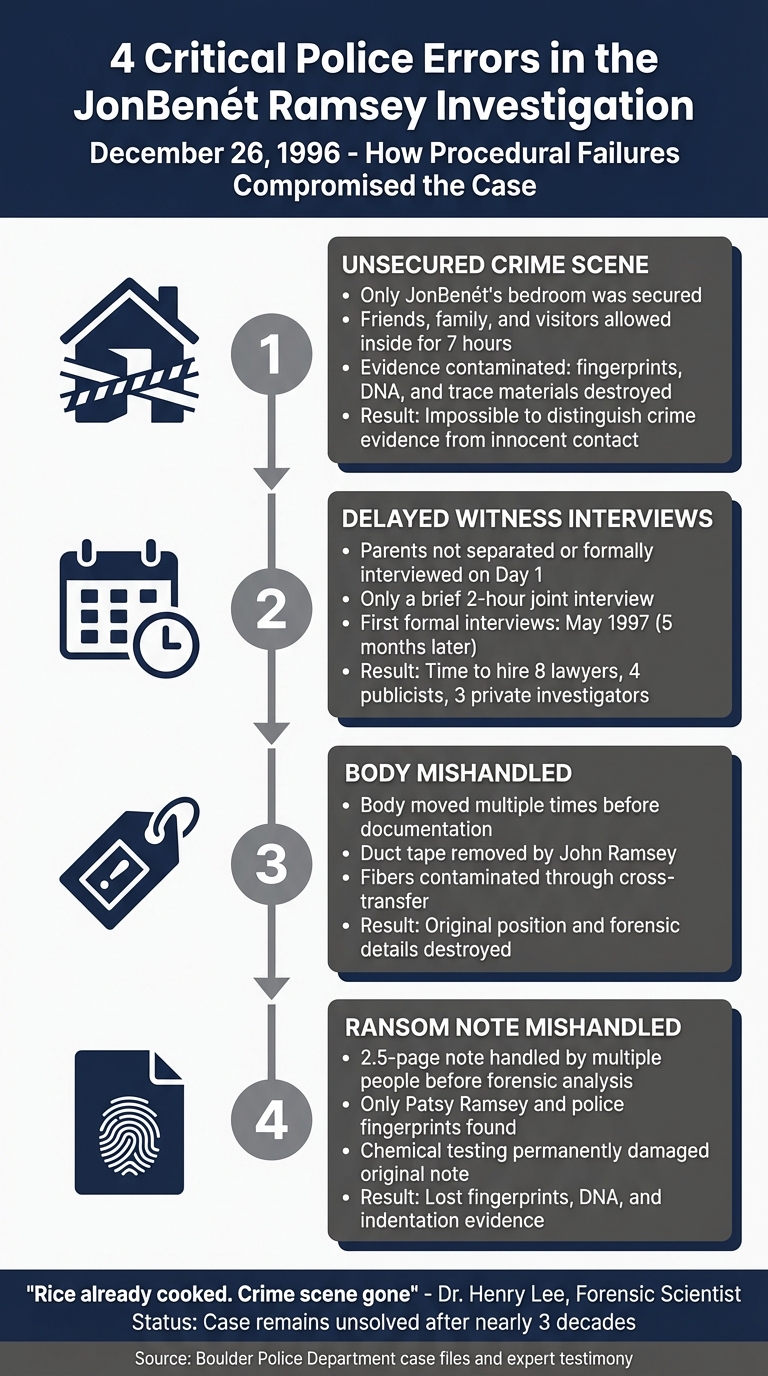
4 Critical Police Errors in JonBenét Ramsey Investigation
Unraveling the Mysteries: JonBenet Ramsey, Ransom Notes, and Investigative Missteps
Crime Scene Was Not Secured
When Boulder police arrived just minutes after the 911 call, they approached the situation as a kidnapping rather than a possible homicide. As a result, only JonBenét's bedroom was secured, leaving the rest of the house open and vulnerable to contamination.
Over the following hours, friends, family members, victim advocates, and even the family’s minister were allowed inside the home. These visitors moved items, cleaned surfaces, and unintentionally compromised crucial evidence like fingerprints and DNA. By 1:00 p.m. - seven hours after police arrived - the crime scene had been heavily disturbed. Detective Linda Arndt then instructed John Ramsey and family friend Fleet White to search the house. When John found JonBenét’s body in the basement wine cellar, he moved her, further contaminating the scene and disturbing critical forensic evidence before investigators could properly document it. These early errors severely impacted the integrity of the evidence and complicated the investigation.
How This Damaged Evidence
The lack of scene security made it nearly impossible to differentiate between evidence related to the crime and traces left by untrained individuals. For example, an unidentified Hi-Tec hiking boot print near JonBenét’s body and an unknown palm print on the wine cellar door could not be conclusively tied to an intruder because of the uncontrolled access to the scene.
The contamination also affected DNA evidence. Touch DNA found on JonBenét’s clothing became a point of contention, as the compromised scene raised the possibility that the DNA was deposited through innocent contact rather than by the perpetrator. Former Boulder Police Chief Mark Beckner highlighted this issue, stating:
"Exonerating anyone based on a small piece of evidence that has not yet been proved to even be connected to the crime is absurd".
Had the scene been properly managed, investigators might have preserved vital evidence that could have clarified the case.
How to Properly Secure a Crime Scene
The mistakes made in this case underscore the importance of following strict crime scene protocols to ensure evidence remains intact.
Establish a strict perimeter immediately.
The entire premises - not just the immediate area of the suspected crime - should be secured to protect any potential evidence, even in unexpected locations.
Limit access to essential personnel only.
Non-essential individuals, including family members and friends, should be removed from the scene. A log should document every person who enters or exits to maintain accountability.
Prohibit civilians from handling evidence or searching the scene.
Allowing John Ramsey and Fleet White to search the house violated basic crime scene protocols and led to further contamination. Only trained law enforcement professionals should conduct searches to ensure evidence is preserved.
Key Witnesses Were Not Interviewed Promptly
On December 26, 1996, the day JonBenét Ramsey’s body was discovered, Boulder police missed a crucial step: they failed to separate and formally interview John and Patsy Ramsey. Instead, a brief two-hour joint interview was conducted. By the afternoon, attorney Mike Bynum intervened, stopping further questioning and allowing the Ramseys to align their accounts with friends who were present . This lapse caused delays that ultimately hindered the investigation.
Former Boulder Police Chief Mark Beckner later admitted this was a critical misstep:
"We also should have separated John and Patsy and gotten full statements from them that day. Letting them go was a big mistake, as they soon lawyered up and we did not get to formally interview them again until May of 1997."
Several factors contributed to this failure. The Boulder Police Department was understaffed due to the Christmas holiday, leaving too few officers to handle both the crime scene and interviews. Beckner described the situation as a "perfect storm" of confusion, where standard procedures were overlooked. Additionally, investigators faced pressure from the District Attorney’s office to avoid being too aggressive with the Ramseys, given their high standing in the community.
What Delayed Interviews Cost the Investigation
The five-month delay before the Ramseys' first formal interviews gave them ample time to build a strong legal defense. They hired eight lawyers, four publicists, and three private investigators. Before sitting down with police, they appeared on CNN on January 1, 1997, using the platform to defend themselves publicly - well in advance of their May 1997 interviews . This delay cost investigators the chance to capture unguarded reactions and crucial details that might have emerged in spontaneous statements.
Former FBI Agent Ron Walker pointed to this as the investigation’s most glaring failure:
"The biggest fault with the Boulder Police Department's investigation was the failure to interview JonBenet's parents Patsy and John Ramsey separately straight after her body was discovered."
The lack of immediate, separate questioning also opened the door for witnesses to coordinate their stories. For instance, reporter Carol McKinley noted that John Ramsey contacted his pilot shortly after discovering JonBenét’s body to arrange an out-of-town flight. Weeks passed before police managed to conduct interviews, further complicating the case.
Proper Witness Interview Procedures
This case underscores the importance of following strict protocols for witness interviews from the outset. Here’s what should have been done:
- Separate witnesses immediately. Witnesses should be placed in different locations upon arrival at a crime scene to prevent them from sharing information or aligning their accounts.
- Conduct formal interviews on day one. Investigators must prioritize obtaining detailed, signed statements before witnesses consult attorneys or public relations teams. Once legal counsel is involved, spontaneous testimony becomes far less likely .
- Avoid external influences. Investigators should adhere to standard procedures, regardless of pressure from influential individuals or offices. This is especially critical given the statistical likelihood of family involvement in child homicide cases (12-to-1 odds).
- Ensure adequate staffing. Law enforcement agencies need contingency plans to ensure sufficient personnel are available to handle critical cases, even during holidays or off-hours .
These procedural safeguards are essential to preserving the integrity of an investigation and preventing the kind of setbacks seen in the JonBenét Ramsey case.
The Body Was Mishandled
The investigation into JonBenét Ramsey's death faced another major setback when her body was mishandled. On December 26, 1996, at 1:00 p.m. - seven hours after the initial 911 call - John Ramsey discovered JonBenét's body in the basement wine cellar. Instead of waiting for forensic documentation, Ramsey removed her body, and later Detective Linda Arndt moved it again, placing it near the Christmas tree. These actions disrupted critical evidence and reflected a broader pattern of investigative missteps.
What Went Wrong with Evidence Handling
Relocating JonBenét's body destroyed essential forensic details, including its original position and the arrangement of ligatures, making it nearly impossible to reconstruct the scene accurately. When John Ramsey removed the duct tape from her mouth, it likely eliminated potential fingerprints, DNA, or other trace evidence.
The movement of the body also led to fiber contamination. Fibers from John Ramsey's black wool shirt and Patsy Ramsey's jacket were later found on JonBenét’s clothing, the ligature, the blanket, and the duct tape. Carrying the body upstairs increased the risk of cross-contamination, potentially transferring evidence between the basement and other areas of the house.
The situation worsened when Patsy Ramsey was permitted to embrace JonBenét’s body after it had been moved to the living room. Former Boulder Police Chief Mark Beckner later expressed regret over these failures:
"I wish we would have done a much better job of securing and controlling the crime scene on day one."
These errors underscore the critical importance of adhering to strict evidence-handling protocols to preserve the integrity of an investigation.
Correct Evidence Handling Procedures
Proper evidence handling starts with ensuring a body remains untouched until forensic teams or the coroner fully document its original position. Any searches of a potential crime scene must be closely monitored by law enforcement to prevent unauthorized movement or tampering with evidence. In this case, Detective Arndt instructed John Ramsey and family friend Fleet White to search the house unsupervised, a decision that had disastrous consequences.
A strict chain of custody must also be maintained to prevent fiber and DNA transfer between suspects and the victim. The entire property should be treated as a potential crime scene, with all areas secured. However, in the Ramsey case, only JonBenét’s bedroom was initially cordoned off, leaving the rest of the house open to contamination by family members and visitors. Additionally, a coroner or medical examiner should conduct an initial examination at the scene before the body is removed to ensure no evidence is lost.
"Once Ramsey, and then Arndt, moved the body, they compromised whatever evidence may have been left on it or in the room." - Newsweek
The Ransom Note Was Mishandled
Investigators mishandled the 2.5-page ransom note found in the Ramsey home, allowing multiple individuals to handle it before forensic analysis could be conducted. This mishandling compromised potential evidence, such as latent fingerprints and other trace materials that might have identified the author. The note itself was written on a standard household notepad, readily available within the home.
Forensic Evidence Lost from the Note
The repeated handling of the ransom note destroyed any latent fingerprints that could have led to the perpetrator. When investigators eventually analyzed the note, only the fingerprints of Patsy Ramsey and law enforcement officers were found. This mishandling also likely erased any touch DNA or skin cells from the original author, leaving investigators with no viable trace evidence.
Additionally, the investigators failed to secure the notepad immediately. This oversight meant they couldn’t use Electrostatic Detection Analysis (ESDA) to check for indentations left by missing pages, which could have revealed whether practice drafts existed. Pages 1–12 and 17–25 were missing from the pad, and this lost opportunity hindered the investigation. The document's degradation also complicated handwriting analysis. While some experts believed the writing resembled Patsy Ramsey's, others ruled her out. Later, a federal court concluded it was highly unlikely that she authored the note.
These errors highlight how critical it is to handle key documents with care from the moment they are discovered.
How to Handle Document Evidence
The mishandling of the ransom note mirrored the broader lapses in crime scene protocol, further damaging the investigation.
Document evidence should always be isolated immediately upon discovery. Placing the document in a clear, protective envelope can help prevent contamination. Investigators must wear gloves and use tools like tweezers to avoid transferring their own fingerprints or DNA onto the paper. A strict chain of custody is essential, ensuring that every person who handles the document is documented.
Testing should follow a specific sequence, beginning with DNA analysis to preserve as much evidence as possible. Chemical treatments, which can permanently alter documents, should only be applied after consulting forensic document examiners. In the Ramsey case, chemical testing for palm prints permanently damaged the original note. Investigators should also collect formal and spontaneous handwriting samples from suspects for comparison, as it’s challenging for someone to maintain a disguised handwriting style across a lengthy note.
What Future Investigations Can Learn
The Boulder Police Department's handling of the JonBenét Ramsey case highlights how limited experience and a reluctance to seek outside expertise can cause irreparable harm to an investigation. With little experience in handling major crimes, the department missed critical opportunities by not involving specialized agencies early on. This case underscores how essential it is for local law enforcement to acknowledge their limitations and actively seek support in complex, high-profile cases.
Working with Other Agencies
Collaboration with outside agencies brings in expertise that small departments often lack. High-profile cases generate a massive amount of evidence and leads, which can overwhelm local resources.
In December 2023, Boulder Police Chief Maris Herold and District Attorney Michael Dougherty enlisted the Colorado Cold Case Review Team for a fresh evaluation of the Ramsey case. This team included experts from the FBI, the Colorado Bureau of Investigation (CBI), and private forensic labs. Together, they digitized the case file - comprising 1,000 interviews, 1,000,000 pages of documentation, and nearly 2,500 pieces of evidence - while analyzing samples from over 200 individuals.
"As with any cold case homicide in Colorado, the overarching goal is to look at the facts and evidence with fresh eyes and an open mind, armed with the latest developments in forensic science." - Michael Dougherty, District Attorney
This collaboration allows for the use of advanced forensic tools that local departments often lack, such as cutting-edge DNA testing and genetic genealogy. Federal and state partners bring these resources to the table, ensuring that investigations stay current with evolving technology. They also help prevent investigative burnout, which can happen when local detectives are overwhelmed.
The original investigation was hindered by conflicts between the Boulder Police and the District Attorney's office, which stalled progress. Establishing clear protocols for communication and evidence-sharing between agencies can avoid such disputes, ensuring timely access to resources and expertise.
Just as important as external support is ensuring local officers are well-trained to handle the critical early stages of an investigation.
Training Requirements for Law Enforcement
Standard investigative protocols - like securing crime scenes, separating witnesses, and properly handling evidence - are only effective if officers follow them. Failures in the Ramsey case weren’t due to a lack of knowledge but rather a failure to apply basic procedures.
Former Boulder Police Chief Mark Beckner admitted the department should have secured the crime scene and conducted formal interviews with witnesses immediately. Staffing shortages during the holiday season contributed to these mistakes, but proper training could have ensured that even a skeleton crew understood the importance of controlling the scene and separating witnesses. Law enforcement agencies must prioritize regular training in homicide investigation techniques, emphasizing the critical nature of the first hours of a case.
Internal audits are another essential tool. In 2022, a review of the Boulder Police Department revealed that five officers had failed to fully investigate assigned cases between 2019 and 2022, leading to disciplinary actions. Regular audits help identify when detectives are struggling or neglecting leads, allowing supervisors to intervene before cases go cold. These reviews should also hold supervisors accountable for overseeing case progress.
For officers who fail to follow protocols, mandatory additional training and Performance Improvement Plans (PIPs) should be standard. Departments also need to modernize their case management systems. Searchable databases can prevent critical tips and leads from getting lost in outdated paper files.
"We are committed to following up on every lead and we are continuing to work with DNA experts and our law enforcement partners around the country until this tragic case is solved." - Steve Redfearn, Boulder Police Chief
To avoid prolonged unsolved cases, local departments must seek specialized assistance and adhere to established protocols. When faced with cases beyond their expertise, immediate collaboration with experienced agencies and strict procedural discipline are key to delivering justice.
Conclusion
The JonBenét Ramsey case highlights how procedural missteps can derail even the most high-profile investigations. Unsecured crime scenes, contaminated evidence, and delays in interviewing witnesses created challenges that still haunt the case nearly three decades later. These errors underscore the need to revisit and refine investigative protocols.
The issues weren’t due to a lack of knowledge - basic procedures were already in place in 1996. Instead, factors like holiday staffing shortages, limited experience with major crimes, and tensions between the police and the District Attorney's office prevented proper execution. Forensic scientist Dr. Henry Lee famously summed up the compromised crime scene, stating:
"Rice already cooked. Crime scene gone"
Looking ahead, modern tools such as advanced DNA analysis and stronger inter-agency collaboration present opportunities to improve investigative outcomes. The Boulder Police Department’s December 2023 decision to convene a Cold Case Review Panel, in partnership with the FBI and the Colorado Bureau of Investigation, reflects how external expertise and cutting-edge technology can breathe new life into stalled cases.
To truly serve victims and safeguard communities, law enforcement must commit to learning from past mistakes. Enhanced training, seamless cooperation between agencies, and unwavering adherence to protocols are essential steps toward justice.
FAQs
What police mistake caused the most harm to the case?
The most critical misstep in the JonBenét Ramsey case was the mishandling of the crime scene and the initial stages of the investigation. Police failed to properly secure the area right away and did not collect comprehensive statements from JonBenét’s parents. These early errors, compounded by staffing shortages during the holiday season, undermined the integrity of the evidence and severely hampered the investigation. As a result, the case remains unsolved, with the perpetrator still unidentified.
Why is the disputed DNA still important?
The controversial DNA evidence has played a key role in shaping theories about the killer's identity, impacting both investigative approaches and public perception. Recently, there’s been a push to revisit this evidence with more advanced testing techniques, aiming to determine its significance and whether it could shed new light on the case.
Could new DNA tech still solve it?
Advances in DNA technology hold the potential to shed new light on the JonBenét Ramsey case. Investigators have been considering the use of more advanced DNA testing techniques on critical pieces of evidence. These methods could reveal fresh insights or help confirm theories that have long been debated.