
JonBenét Ramsey Case: Timeline of Key Events
A timeline of the JonBenét Ramsey investigation: ransom note, forensic evidence, grand jury actions, DNA breakthroughs, and renewed probes through 2025.
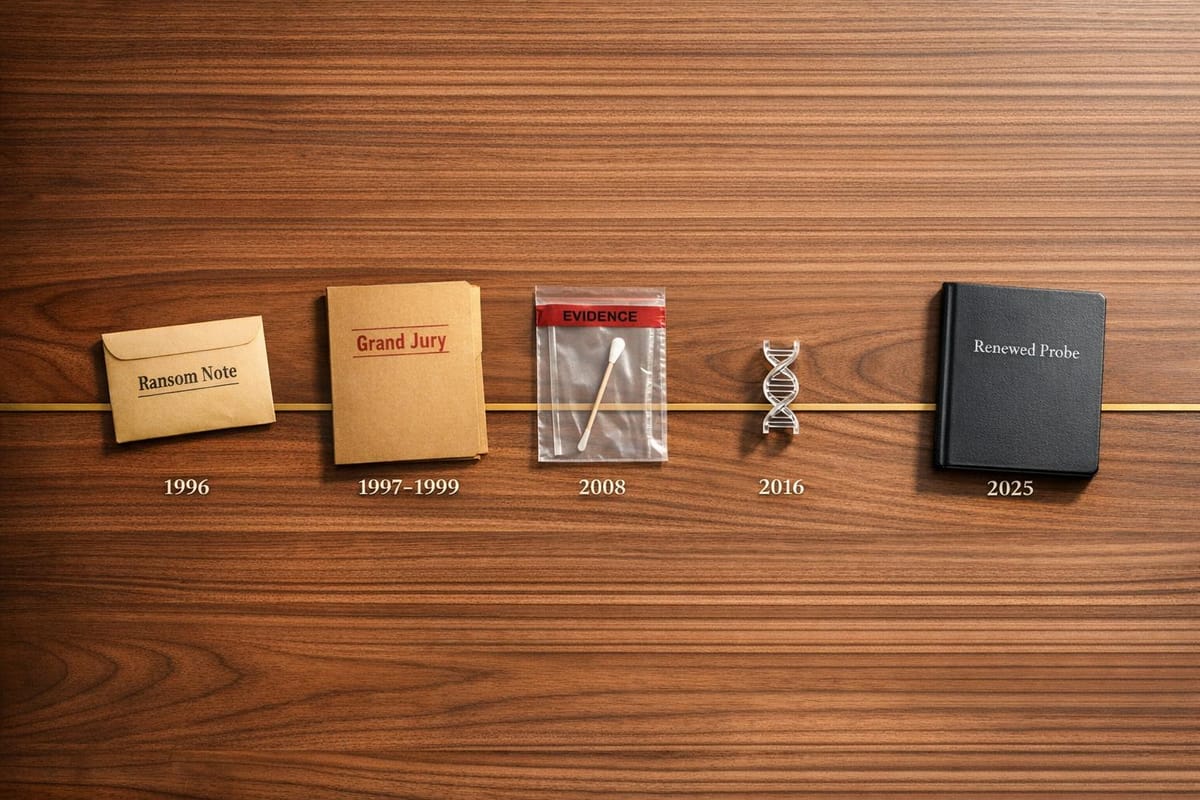
The JonBenét Ramsey case remains one of the most perplexing unsolved crimes in U.S. history. On December 26, 1996, six-year-old JonBenét was tragically found dead in her Boulder, Colorado home. A ransom note, a fractured investigation, and conflicting evidence have kept the case unresolved for nearly 30 years. Key details include:
- Ransom Note: Found in the home, demanding $118,000 - matching John Ramsey's Christmas bonus. Analysts often examine John Ramsey's interviews for inconsistencies regarding these details.
- Crime Scene: JonBenét was discovered in the basement with evidence of strangulation and blunt force trauma.
- DNA Evidence: Male DNA found on her clothing does not match the Ramsey family but remains unidentified.
- Grand Jury Indictment: In 1999, the jury voted to indict the parents, but the DA declined to prosecute due to insufficient evidence.
- Exoneration: In 2008, advanced DNA testing officially cleared the Ramsey family.
Despite advancements in forensic science and renewed investigative efforts, questions about the ransom note, missing evidence, and unidentified DNA linger. Investigators continue to explore new leads and reexamine evidence using modern techniques, with results expected in 2026.
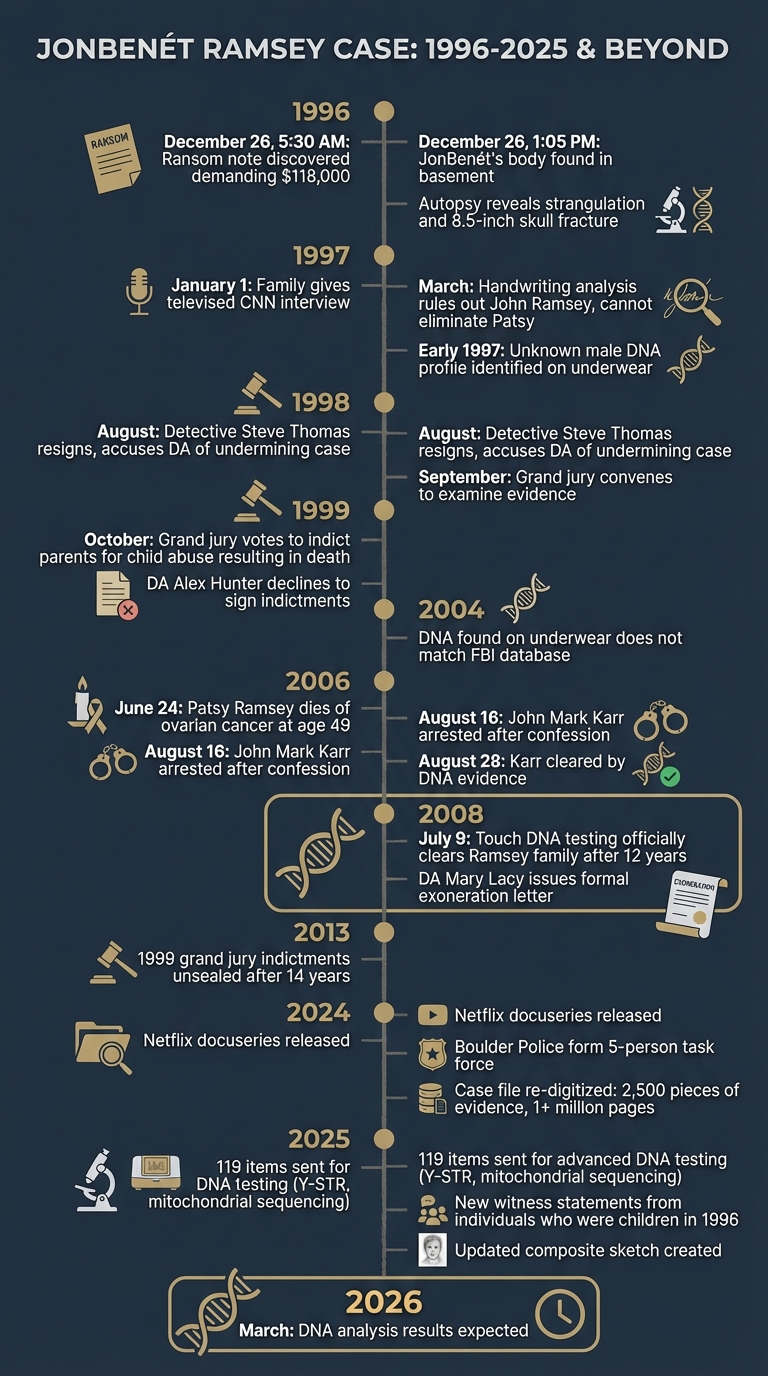
JonBenét Ramsey Case Timeline: 1996-2025 Key Events and Developments
The Crime and Early Investigation (1996–1997)
Discovery of the Ransom Note and JonBenét's Body
On the morning of December 26, 1996, at around 5:30 a.m., Patsy Ramsey found a 2.5-page ransom note on the back staircase of the family home. The note demanded $118,000 in $100 and $20 bills - a figure that matched John Ramsey's recent Christmas bonus. Written on a household notepad with a felt-tip pen, the note claimed to be from a "small foreign faction", threatened to decapitate JonBenét, and was signed with the cryptic phrase "Victory! S.B.T.C.".
Officer Rick French arrived at the scene by 6:00 a.m. During his search, he overlooked a basement storage room door. Hours later, at 1:05 p.m., John Ramsey, following instructions from Detective Linda Arndt to search the house, discovered JonBenét's body in a windowless basement room. She was found with black duct tape covering her mouth, a garrote made from white cord around her neck, her wrists bound, and partially wrapped in a white blanket.
The notepad used for the ransom note had missing pages - specifically pages 1–12 and 17–25 - which were never recovered. Because the note suggested a kidnapping, the police failed to secure the house as a crime scene, allowing family members and friends to roam freely for hours. John Ramsey's decision to move JonBenét's body from the basement to the living room further compromised potential forensic evidence.
These early errors would have lasting consequences as investigators moved on to the autopsy and evidence collection phases.
Autopsy Results and Evidence Collection
The autopsy revealed that JonBenét had died from strangulation caused by the garrote, as well as a severe 8.5-inch skull fracture from blunt force trauma. At the time of her death, she weighed about 45 pounds and was 47 inches tall. Interestingly, fragments of undigested pineapple were found in her stomach, matching a bowl of pineapple in the kitchen.
Key evidence collected at the scene included the garrote, which was fashioned from a white cord and a broken paintbrush handle from Patsy Ramsey's art supplies. A "Hi-Tec" brand shoe print was discovered in the dust near JonBenét's body. Investigators also noted a red ink heart drawn on her left palm. Most notably, early in 1997, an unknown male DNA profile was identified from a bloodstain on her underwear. However, the roll of black duct tape used on JonBenét was never found.
By March 1997, handwriting analysis ruled out John Ramsey as the author of the ransom note but could not eliminate Patsy Ramsey. The note's unusual length, the use of household materials, and the specific reference to John Ramsey's bonus led authorities to suspect that the crime scene may have been staged.
Media Coverage and Family Involvement
The case quickly became a media sensation, with intense focus on JonBenét's involvement in child beauty pageants. Tabloids labeled Patsy Ramsey as a "stage mother" and highlighted JonBenét's seemingly mature appearance, creating an image that the family struggled to counter.
By January 7, 1997, the police tip line had received nearly 300 calls, and Boulder County Crime Stoppers offered a $100,000 reward, funded by the Ramsey family and others. Within days of the murder, the Ramseys had hired legal counsel, a publicist, and private investigators.
On January 1, 1997, the family gave a televised interview on CNN, which reportedly surprised the Boulder Police. During the interview, Patsy Ramsey made a chilling statement:
There is a killer on the loose… if I were a resident of Boulder, I would tell my friends to keep - keep your babies close to you, there's someone out there.
John Ramsey later criticized the Boulder Police for their handling of the investigation, stating:
The fundamental flaw in our case was a refusal to accept experienced help from the outside.
He recalled that two skilled Denver homicide detectives had offered immediate assistance but were turned away. The case became even more complicated as the Boulder Police Department focused on building a case against Patsy Ramsey, while the District Attorney's office treated the family as victims. These conflicting approaches only deepened the challenges surrounding the investigation as public suspicion continued to grow.
Suspicions and Legal Developments (1997-2000)
The Ramseys Under Investigation
By April 1997, District Attorney Alex Hunter had identified John and Patsy Ramsey as the primary suspects in the case. Handwriting analysis cleared John as the author of the ransom note but couldn't definitively rule out Patsy. Additionally, forensic evidence tied red fibers found on the duct tape covering JonBenét's mouth to a sweater Patsy reportedly wore that night. Adding to the intrigue, an enhanced version of the 911 call allegedly revealed the voice of 9-year-old Burke Ramsey in the background, contradicting the parents' claim that he was asleep when police arrived.
Although the Ramseys quickly hired legal representation, they delayed formal interviews with the police for four months. On April 30, 1997, Patsy underwent a 6.5-hour interrogation, while John was questioned for just two hours. Remarkably, the couple did not hand over the clothing they wore on the night of the crime until 13 months later.
Tensions within the investigation team became evident. Detective Steve Thomas resigned in August 1998, accusing the DA's office of undermining the case by refusing to pursue evidence against the family. On the other hand, investigator Lou Smit also stepped down, arguing that the Ramseys were being unfairly targeted. Reflecting on the situation, John Ramsey later commented:
"They'd made up their mind that it was the parents, some or one of the parents, they didn't know which one."
By June 1998, investigators had amassed 1,058 pieces of evidence, but the case remained at a standstill. The Boulder police's leading theory suggested that Patsy had killed JonBenét in a fit of anger over bed-wetting and then staged a kidnapping to cover it up. As suspicions grew, legal proceedings began to take shape.
The Grand Jury Indictment
In September 1998, a Boulder County grand jury convened to examine the case. Over the course of 13 months, jurors reviewed more than 30,000 pieces of evidence and heard testimony from numerous witnesses.
In October 1999, the grand jury voted to indict John and Patsy Ramsey - not on charges of murder but for child abuse resulting in death and for acting as accessories to a crime. The indictment alleged:
"John Bennett Ramsey did unlawfully, knowingly, recklessly and feloniously permit a child to be unreasonably placed in a situation which posed a threat of injury to the child's life or health, which resulted in the death of JonBenet Ramsey."
A second count accused John Ramsey of:
"unlawfully, knowingly and feloniously render assistance to a person, with intent to hinder, delay and prevent the discovery, detention, apprehension, prosecution, conviction and punishment of such person... knowing the person being assisted has committed... the crime of Murder in the First Degree."
Legal analyst Dan Recht described the grand jury's decision as a middle ground:
"In a sense, they seem to be classic compromise grand jury decision. They can't decide whether to indict on murder. They can't decide not to indict at all. So they compromise in between."
However, District Attorney Alex Hunter declined to sign the indictments, stating:
"I and my prosecutorial team believe we do not have sufficient evidence to warrant the filing of charges against anyone who has been investigated at this time."
The indictments remained sealed for 14 years until a judge ordered their release in 2013 following a lawsuit by a reporter. This left the Ramseys in a state of legal uncertainty - neither formally charged nor exonerated - while public suspicion continued to follow them into the new millennium.
Major Developments and Setbacks (2001-2008)
DNA Testing Clears the Family
Advancements in DNA technology brought significant changes to the investigation. In 2004, the Ramseys' attorney revealed that DNA found on JonBenét's underwear did not match any profiles in the FBI database, lending support to the intruder theory. By July 2008, touch DNA testing - capable of analyzing smaller, degraded samples - identified a male DNA profile on JonBenét's long johns and underwear. This profile did not match John, Patsy, or Burke Ramsey.
On July 9, 2008, Boulder County District Attorney Mary Lacy officially cleared the Ramsey family after nearly 12 years of suspicion. In her letter to John Ramsey, she wrote:
"This new scientific evidence convinces us that it is appropriate ... to state that we do not consider your immediate family, including you, your wife Patsy, and your son Burke, to be under any suspicion in the commission of this crime."
She also acknowledged the toll the prolonged suspicion had taken, describing it as "an ongoing living hell for the Ramsey family and their friends, which added to their suffering from the unexplained and devastating loss of JonBenét." The unidentified male DNA profile was entered into the FBI's national crime database in hopes of finding a match. This development remains a focal point in true crime news regarding the case.
While this forensic breakthrough cleared the family, a dramatic confession soon shifted the focus of the investigation.
The John Mark Karr Confession
On August 16, 2006, John Mark Karr, a 41-year-old former schoolteacher, was arrested in Bangkok after confessing to JonBenét's murder. Karr claimed he was with JonBenét when she died, describing her death as an "accident" following her drugging and sexual assault. He stated, "I loved JonBenét very much. Her death was an accident."
The confession drew widespread media attention, but DNA testing on Karr's hair and saliva samples - conducted after his extradition to Colorado - ruled him out as the source of the DNA found on JonBenét's underwear. Just 12 days after his arrest, prosecutors dropped the case on August 28, 2006. Public Defender Seth Temin voiced his frustration:
"We're deeply distressed by the fact that they took this man and dragged him here from Bangkok, Thailand, with no forensic evidence confirming the allegations against him."
Investigators found no proof that Karr had been in Boulder, Colorado, at the time of the murder. His family provided alibis placing him in Georgia and Alabama during Christmas 1996. Experts and family representatives described Karr as an obsessive follower of the case. Family spokesman Gary Harris called him "a dreamer" and "the kind of guy who wants to be famous." Additionally, Karr faced child pornography charges in Sonoma County, California, dating back to 2001.
As these developments unfolded, the Ramsey family faced another devastating loss.
Patsy Ramsey's Death
On June 24, 2006, Patsy Ramsey passed away at the age of 49 after battling ovarian cancer. Her death came just months before Karr's arrest and two years before the DNA evidence officially cleared her name. Tragically, Patsy never lived to see her family's exoneration. At the time of her death, the Ramseys were still under an "umbrella of suspicion", a situation worsened by years of media scrutiny, public judgment, and the unresolved 1999 grand jury indictment, which remained sealed until 2013. Reuters reported that Patsy Ramsey died "still fighting to clear her name" (Keith Coffman, Reuters).
When District Attorney Mary Lacy issued the formal clearance letter in 2008, she expressed regret that her office had been unable to clear Patsy’s name while she was alive. Patsy's death left the family grieving not only her loss but also the unresolved public perception surrounding the case.
Recent Investigations and Theories (2009-Present)
Continued Public Interest and Media Coverage
The JonBenét Ramsey case continues to captivate public attention, fueled by both investigative progress and media coverage. In 2024, John Ramsey partnered with director Joe Berlinger for the Netflix docuseries Cold Case: Who Killed JonBenét Ramsey? This series provided insights from the Ramsey family's perspective and pushed for the involvement of independent DNA agencies like Othram Labs to advance the case.
Public interest has been a double-edged sword. On one hand, it has brought forward new leads; on the other, it has muddied the waters with a mix of credible tips and unfounded speculation. Lou Smit's family remains actively involved, maintaining a detailed spreadsheet of 887 potential suspects, which they are systematically narrowing down through DNA testing. This combination of public engagement and forensic advancements keeps hope alive for a resolution.
Current Investigation Status
Law enforcement has also stepped up its efforts, leveraging modern forensic science. In early 2024, under Chief Stephen Redfearn, the Boulder Police Department assembled a five-person task force to revisit the case. This team undertook the massive task of re-digitizing the case file, which includes about 2,500 pieces of physical evidence and over one million pages of documentation.
By late 2025, 119 critical items were sent to advanced forensic labs for analysis using cutting-edge methods like Y-STR and mitochondrial sequencing. Among the items being reexamined are the binding cord and parts of the garrote mechanism. Investigators aim to determine whether the DNA evidence points to a single male source or multiple contributors. As of December 2025, partial genetic profiles have been identified on two separate items, with further comparison testing expected to wrap up by March 2026.
Chief Redfearn expressed the department's commitment, stating:
The killing of JonBenét was an unspeakable crime and this tragedy has never left our hearts. We are committed to following up on every lead and we are continuing to work with DNA experts and our law enforcement partners around the country until this tragic case is solved.
The investigation has also uncovered new witness statements from individuals who were children in 1996. These witnesses recalled seeing an unfamiliar man carrying a small duffel bag near the Ramsey property on December 25, 1996. This information has led to the creation of an updated composite sketch. Meanwhile, forensic technicians are working with software designed to mimic 1990s technology to retrieve subscriber data from 160 cellular devices that connected to towers near the Ramsey home within a 72-hour window around the time of the murder.
John Ramsey remains vocal in his calls for external assistance. He has advocated for the use of genetic genealogy, a method that has solved other notable cold cases, to create reverse family trees and identify suspects through public DNA databases. With Colorado's convicted-offender database now housing over 250,000 profiles, the chances of finding a familial DNA match have significantly increased.
The Search for JonBenét's Killer | Full Episode
Unanswered Questions and Future Prospects
Even after nearly 30 years, the JonBenét Ramsey case remains a puzzle filled with unanswered questions that continue to challenge investigators and intrigue the public.
One of the most baffling pieces of evidence is the ransom note. Found inside the Ramsey home, it was written on a notepad from the house and stretched across 2.5 pages. The note demanded $118,000 - exactly matching John Ramsey's 1996 Christmas bonus. While handwriting experts ruled out John and Burke Ramsey as the authors, they could not conclusively eliminate Patsy Ramsey. The note itself raises suspicions due to its unusual quirks: simple words were misspelled, yet more complex terms were written correctly. Phrases like "and hence", which are rarely used, have only deepened the mystery. Adding to the confusion, several pages from the notepad were never recovered, leaving both the motive and authorship unresolved.
The DNA evidence adds another layer of complexity. Male DNA, found in JonBenét's underwear and under her fingernails, was pivotal in officially clearing the Ramsey family in 2008. However, a 2016 analysis revealed the sample is a mixture from at least two individuals. Despite being entered into the FBI's CODIS database in 2004 - which now contains over 1.6 million profiles - no matches have been found. The Boulder Police Department has acknowledged the challenges, stating, "The amount of DNA evidence available for analysis is extremely small and complex. The sample could, in whole or in part, be consumed by DNA testing."
Beyond the DNA, other physical evidence remains unresolved. Items like the duct tape, binding cord, and a paintbrush piece are missing, leaving critical gaps in the investigation. A Hi-Tec shoe print found in the basement and a Caucasian hair - described as "pubic or auxiliary" - discovered on the blanket also remain unlinked to anyone, including the Ramsey family.
These lingering mysteries have spurred efforts to leverage new forensic techniques. Currently, 119 pieces of evidence are undergoing advanced Y-STR and mitochondrial DNA sequencing, with results expected by March 2026. Investigators aim to determine whether the DNA is from a single individual or multiple contributors. John Ramsey has also pushed for genetic genealogy, suggesting, "Let's do a reverse family tree and see if he (the killer) had a relative living in Boulder in 1996. That's what we're asking the police to do." With over 250,000 profiles now in Colorado's convicted-offender database, the chances of finding a familial DNA match could improve.
However, legal and procedural obstacles remain. Evidence stored in a faulty refrigerator in 1999 may face chain-of-custody issues, and while first-degree murder has no statute of limitations, the same cannot be said for many related felony sex offenses, which have already expired.
FAQs
Why did the grand jury indict the Ramseys if no charges were filed?
In 1999, a grand jury concluded there was enough evidence to indict the Ramseys and explore their possible involvement in the case. Despite this, the district attorney decided not to move forward, citing a lack of sufficient evidence to press formal charges.
How strong is the unidentified male DNA evidence, and could it be contamination?
The male DNA evidence in the JonBenét Ramsey case has raised doubts among experts. Questions have been raised about its relevance, the potential for contamination, and the discovery that the DNA came from at least two people other than JonBenét. Despite these revelations, the evidence has yet to identify a clear suspect.
What new DNA methods could realistically identify the killer by 2026?
By 2026, advancements in DNA technology could help identify the killer by refining genetic analysis and matching evidence, like DNA found on gloves, against FBI databases. Recent successes in cracking cold cases highlight how these methods are transforming the ability to solve investigations that have remained unresolved for years.