
Chris Watts Wrongful Death Lawsuit: $6M Settlement
A $6 million wrongful-death judgment awards $1M per death and $3M for emotional suffering, with liens and 8% interest to prevent the defendant from profiting.
Chris Watts, convicted of murdering his pregnant wife Shanann and their two daughters in 2018, agreed to a $6 million wrongful death settlement. This civil lawsuit, filed by Shanann's parents, Frank and Sandy Rzucek, aimed to hold Watts financially accountable and prevent him from profiting from his crimes, such as through book or movie deals.
The settlement includes $1 million for each death and $3 million for emotional suffering, with 8% annual interest applied to unpaid amounts. While the Rzuceks are unlikely to recover the full amount due to Watts' limited assets and prison income, the judgment ensures any future earnings will go to the victims' estate. This case underscores the legal system's dual approach: criminal penalties for justice and civil remedies to address the emotional and financial toll on victims' families.
Shanann Watts` parents file wrongful death lawsuit against Christopher Watts
The Watts Family Murders: What Happened
In the early hours of August 13, 2018, Shanann Watts returned to her Colorado home at 1:48 a.m. after a work trip to Arizona. She was 15 weeks pregnant with a baby boy she and her husband, Chris Watts, planned to name Nico. Later that morning, following an argument about their strained marriage, Chris strangled Shanann in their bedroom, ending her life.
Chris then loaded Shanann's body into his work truck while their two daughters, 4-year-old Bella and 3-year-old Celeste, were still alive in the vehicle. He drove to a remote oil site owned by Anadarko Petroleum, where he smothered Celeste with a blanket. Bella, his eldest daughter, pleaded for her life before he overpowered her as well. Chris buried Shanann in a shallow grave and disposed of his daughters by forcing their small bodies through 8-inch-wide hatches into oil tanks.
Later that day, Shanann’s friend Nickole Atkinson became concerned when Shanann missed a doctor’s appointment and failed to respond to messages. Atkinson contacted the police, prompting a welfare check at the Watts home around 1:40 p.m. Officers found Shanann’s phone, purse, keys, and wedding ring inside, raising suspicions. A neighbor’s security footage later revealed Chris backing his truck into the garage early that morning, contradicting his claim that Shanann had left the house with their children.
Timeline of Events
The following timeline highlights the key moments of this tragic case:
| Date | Event |
|---|---|
| Aug 13, 2018 | Shanann, Bella, and Celeste are murdered; Shanann is reported missing. |
| Aug 14, 2018 | Chris appears on television, pleading for his family’s return. |
| Aug 15, 2018 | Chris fails a polygraph test, confesses to killing Shanann, and is arrested. |
| Aug 16, 2018 | Authorities recover the bodies of Shanann, Bella, and Celeste at the oil site. |
| Aug 21, 2018 | Chris is charged with nine felony counts. |
| Nov 6, 2018 | Chris pleads guilty to all charges to avoid the death penalty. |
| Nov 19, 2018 | Chris is sentenced to consecutive life terms without parole. |
Chris initially misled investigators, claiming Shanann had killed their daughters in a fit of rage. However, during a February 18, 2019, prison interview at Dodge Correctional Institution, he provided a detailed 31-page confession, finally admitting to the full extent of his actions.
Criminal Charges and Guilty Plea
Legal proceedings against Chris Watts moved swiftly. Shanann’s mother, Sandra Rzucek, supported a plea deal to avoid the trauma of a drawn-out trial. She explained, "He made the choice to take those lives. I do not want to be in a position of making the choice to take his." The agreement brought some closure to both families, sparing them from years of court battles.
| Charge Type | Number of Counts |
|---|---|
| First-degree murder | 3 |
| First-degree murder (child under 12/position of trust) | 2 |
| Unlawful termination of a pregnancy | 1 |
| Tampering with a deceased human body | 3 |
On November 19, 2018, Judge Marcelo Kopcow sentenced Chris to three consecutive life terms without parole. Additional sentences, totaling 84 years, were imposed for other charges. The judge described the murders as the "most inhumane and vicious" case he had ever encountered. Chris was also ordered to pay $41,807 to cover funeral and burial costs.
This criminal case laid the groundwork for further legal actions, including a wrongful death lawsuit filed by Shanann’s family, the Rzuceks.
The Wrongful Death Lawsuit
On November 19, 2018 - the same day Chris Watts was sentenced for his crimes - Frank and Sandy Rzucek, representing Shanann Watts' estate and the children, filed a civil wrongful death lawsuit in Weld County. The family, with attorney Steven Lambert from the Grant & Hoffman Law Firm, sought justice through this legal action.
Claims Filed by the Rzucek Family
The lawsuit aimed to address the wrongful deaths of Shanann, Bella, and Celeste, while also including an unlawful termination claim for Nico, the unborn child. The family sought compensation for funeral and burial costs, the loss of Shanann's future income, and damages for the immense emotional suffering they endured.
A significant focus of the suit was to prevent Watts from profiting in any way from the murders. This included blocking potential earnings from book deals, movie rights, or sales of property. Attorney Lambert explained their intent:
"The lawsuit is meant to keep Watts from profiting from the murders... Just in case 20 years down the line from now he decides to write a book we could come for that money."
Court filings revealed the profound emotional toll on the Rzucek family:
"They have suffered with anger, loneliness, sadness, and depression. For a substantial period of time... they were unable to work, leave the house, or even eat."
The family also highlighted Watts' initial misrepresentation of the events during the investigation, which added to their anguish.
Chris Watts' Response to the Lawsuit
Despite the detailed claims against him, Watts did not mount any defense. He failed to respond by the legal deadline and chose not to hire a defense attorney for the civil case. Instead, Watts communicated directly with Lambert from prison on several occasions, admitting to the "felonious killing" and confirming he would not contest the suit.
This lack of response led to a default judgment. On November 5, 2019, Watts signed a stipulation agreeing to a $6 million judgment, acknowledging the immense loss suffered by the Rzucek family. Lambert noted Watts' cooperation:
"Based on our conversations with him, he is not fighting this."
The stipulation included a formal acknowledgment from Watts:
"The Defendant stipulates that the death of Shanann, Bella, and Celeste was a tremendous loss to Plaintiffs Franklin Rzucek and Sandra Rzucek and that they have suffered extreme emotional stress and damage as a result of such loss."
The $6 Million Settlement: Breakdown and Legal Meaning
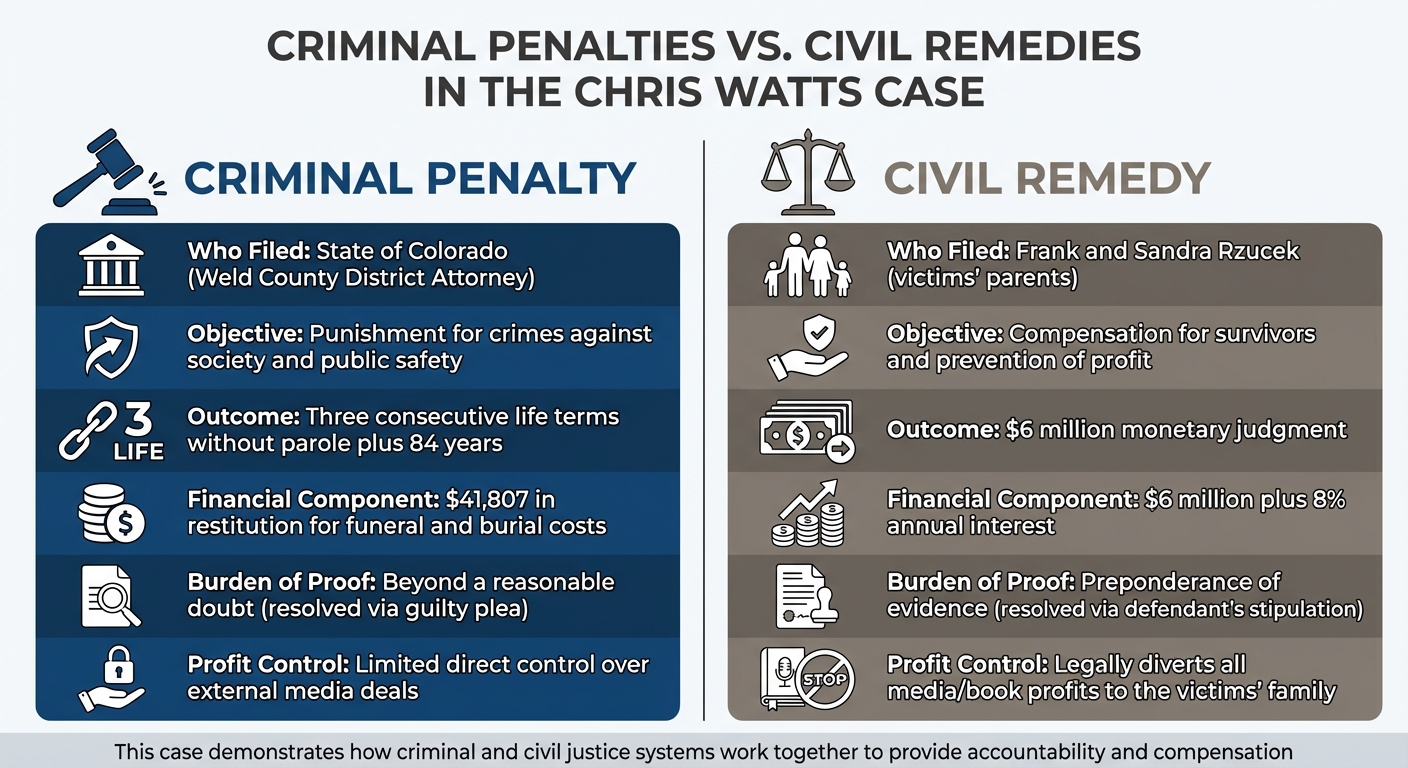
Criminal vs Civil Justice: Chris Watts Case Comparison
This section delves into how the $6 million settlement in the Chris Watts case was calculated and its broader legal implications.
How the $6 Million Was Calculated
Chris Watts agreed to a $6 million wrongful death settlement, broken down as follows: $1 million for each of the three deaths and $3 million for emotional distress. Additionally, the lawsuit included damages for the death of Shanann's unborn child, Nico, as Colorado law allows civil claims for the unlawful termination of a pregnancy.
To ensure accountability, an 8% annual interest rate applies to any unpaid balance, meaning the total owed will grow over time. Separately, in his criminal case, Watts was ordered to pay $41,807 in restitution to cover funeral and burial expenses.
The settlement also includes legal measures to prevent Watts from profiting from his crimes.
Blocking Watts from Profiting
A critical aspect of the settlement is its permanent legal lien on any assets Watts currently owns or may acquire in the future. This ensures that any potential earnings - whether from book deals, movie rights, television interviews, or even the sale of his former home - go directly to the Rzucek family.
Attorney Steven Lambert emphasized that this judgment guarantees the family can claim any profits Watts might attempt to generate from his crimes, regardless of how far in the future that might be.
While it’s unlikely the Rzucek family will collect the full $6 million given Watts' life imprisonment, the legal framework ensures he cannot financially benefit from his notoriety.
Criminal Penalties vs. Civil Remedies
The Watts case illustrates the dual approach of the legal system, with criminal penalties addressing societal justice and civil remedies focusing on compensation and deterrence.
| Feature | Criminal Penalty | Civil Remedy |
|---|---|---|
| Who Filed | State of Colorado (Weld County District Attorney) | Frank and Sandra Rzucek (victims' parents) |
| Objective | Punishment for crimes against society and public safety | Compensation for survivors and prevention of profit |
| Outcome | Three consecutive life terms without parole plus 84 years | $6 million monetary judgment |
| Financial Component | $41,807 in restitution for funeral and burial costs | $6 million plus 8% annual interest |
| Burden of Proof | Beyond a reasonable doubt (resolved via guilty plea) | Preponderance of evidence (resolved via defendant's stipulation) |
| Profit Control | Limited direct control over external media deals | Legally diverts all media/book profits to the victims' family |
In the criminal case, the focus was on punishing Watts through life sentences and restitution for immediate funeral costs. The civil lawsuit, on the other hand, sought broader compensation for emotional suffering and loss of potential future income, while also creating a permanent mechanism to block any future financial gain from his infamy.
Impact on the Rzucek Family
The Family's Emotional Distress
The settlement highlights more than just legal consequences - it sheds light on the immense personal suffering endured by the Rzucek family. The murders shattered Frank and Sandy Rzucek's lives, leaving them unable to live as they once did. Frank Rzucek was diagnosed with post-traumatic stress disorder (PTSD) and, as of August 2019, had not been able to return to work.
Sandy Rzucek expressed the depth of her grief in court filings, describing the loss of her daughter and granddaughters as an overwhelming feeling of hopelessness, like "sinking into the ocean" after losing a lifeboat. She shared that every day feels like a part of her dies, as she constantly mourns and cries for her family.
Adding to their pain, the family endured months of false accusations after Chris Watts initially claimed that Shanann had killed their children. It wasn’t until his February 2019 confession that Shanann’s name was cleared. During this time, the Rzuceks faced harassment, including death threats from conspiracy theorists, which forced them to stay home most of the time. Sandy later revealed an especially haunting detail: "I think the hardest part is knowing our granddaughter watched her sister die, and then begged for her life".
The $3 million awarded for emotional pain serves as recognition of the unrelenting anguish and trauma the Rzucek family continues to endure.
Timeline: Murders to Settlement
| Date | Event |
|---|---|
| August 15, 2018 | Chris Watts is arrested after the bodies are found at an oil site. |
| November 19, 2018 | Watts is sentenced to life in prison; the Rzucek family files a wrongful death lawsuit. |
| November 20, 2018 | A restitution of $41,807 is filed against Watts in the criminal case. |
| February 2019 | Watts provides a detailed confession, clearing Shanann’s name. |
| August 1, 2019 | Court filings reveal Frank Rzucek’s PTSD diagnosis and inability to work. |
| November 5, 2019 | Chris Watts agrees to a $6 million settlement in the civil case. |
| November 18, 2019 | A judge officially orders Watts to pay the $6 million settlement. |
This timeline illustrates not only the pursuit of justice but also the profound and ongoing emotional impact on the Rzucek family. The legal proceedings serve as a formal acknowledgment of their enduring loss and pain.
Conclusion
The settlement in this case does more than just provide financial compensation - it effectively ensures that Chris Watts cannot profit from his crimes. The $6 million wrongful death judgment not only addresses the loss but also prevents Watts from gaining financially through avenues like book deals, movie rights, or media earnings. With an 8% annual interest rate, this debt will continue to grow indefinitely, tying any future assets directly to the Rzucek family. This includes control over assets such as the family home and any potential future income.
This legal resolution highlights the broader scope of justice. While Watts received three consecutive life sentences in criminal court, the civil suit served to formally recognize the devastating emotional and personal toll on the Rzucek family. The criminal restitution of $41,807 covered immediate funeral expenses, but the civil judgment acknowledged the profound emotional trauma and loss of companionship suffered by Frank and Sandy Rzucek.
For families facing similar tragedies, this case demonstrates the importance of pursuing civil actions alongside criminal proceedings. The Rzucek family filed their lawsuit on November 19, 2018 - the same day Watts was sentenced - leveraging his guilty plea to secure an uncontested judgment. Attorney Steven Lambert emphasized the family’s true intent:
"Nobody's really rubbing our hands together and getting dollar signs in our eyes".
Though Watts earns just 10 cents per hour in prison, any future earnings will be directed to the victims' estate, ensuring that accountability extends far beyond his incarceration.
FAQs
Will the Rzucek family actually collect the $6 million?
The Rzucek family is not expected to receive the $6 million from Chris Watts. He simply doesn't have the financial means to pay. The lawsuit's main purpose is to ensure he cannot profit from his crimes in the future.
How does the settlement stop Chris Watts from profiting later?
The settlement guarantees that Chris Watts cannot financially benefit from his crimes. Any income he might earn through book deals, story rights, or similar opportunities must be directed to Shanann Watts' family. Furthermore, he is barred from retaining any money from the sale of the family home.
Why file a civil wrongful death case after a life sentence?
A civil wrongful death case is pursued to obtain financial compensation, ensure the defendant does not benefit from their actions, and acknowledge the emotional suffering of the victims' families. While collecting the awarded compensation might not always be practical, these cases often carry deep symbolic value, offering a sense of justice and holding the defendant accountable.